What Does Escrow Mean? A 2026 Guide for Kalamazoo Homebuyers
What if the most confusing part of your home purchase was actually the ground control keeping your entire investment from crashing? For many Kalamazoo buyers, the term feels like a financial black hole where their hard-earned money disappears. You’ve likely heard the phrase, but what does escrow mean when you’re actually signing papers at a local title company? It’s not just a legal hurdle; it’s a secure holding pattern that ensures neither the buyer nor the seller gets off course before the final touchdown at the closing table.
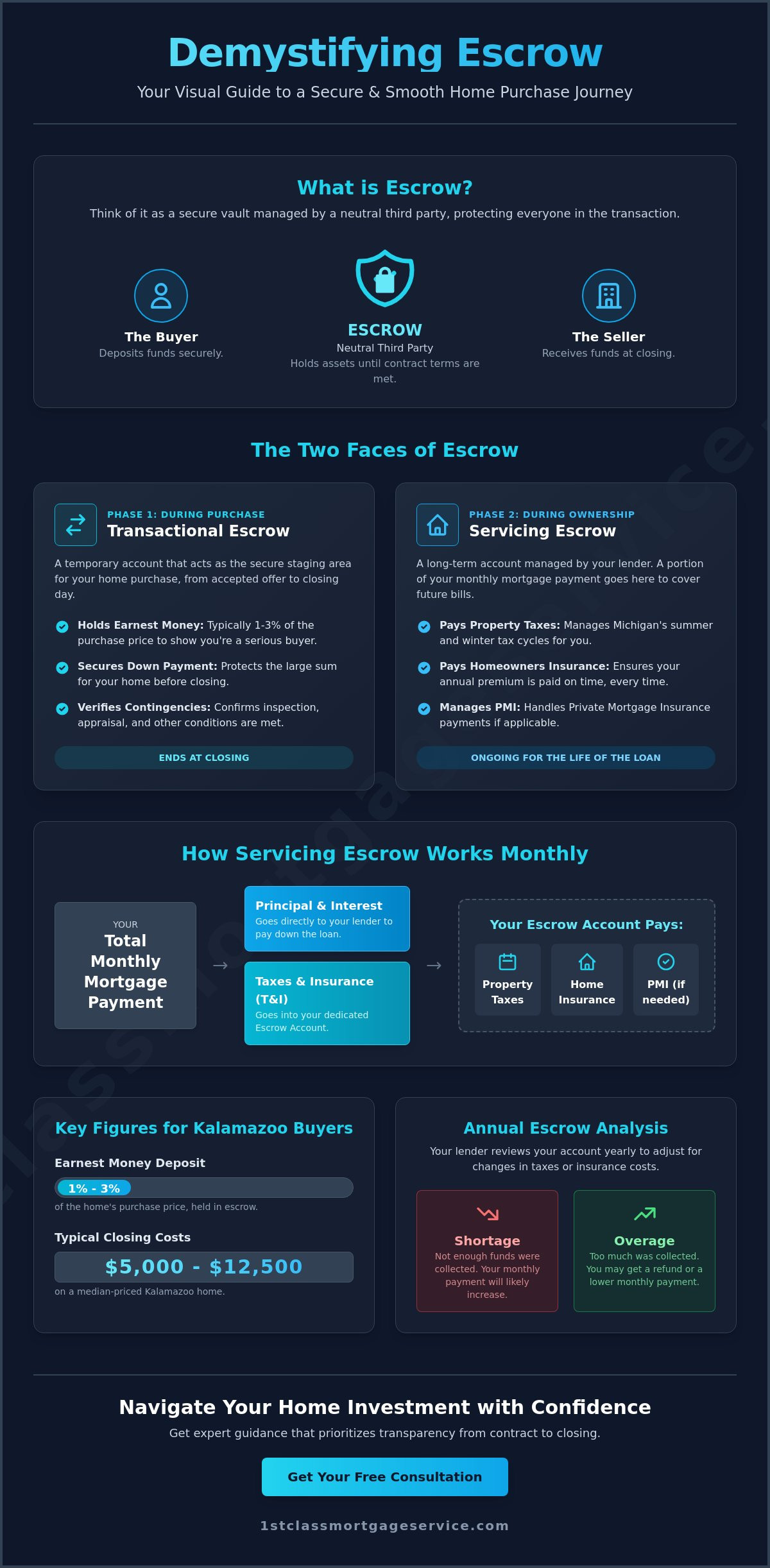
It’s completely normal to feel a bit of turbulence when you’re handing over 1% to 3% of a home’s price as an earnest money deposit. We’re here to act as your co-pilot and help you navigate these clouds. This guide will demystify the escrow process, showing you how it protects your deposit and manages those specific Michigan tax cycles. We’ll break down the two distinct types of escrow, explain why your monthly payment might shift, and help you prepare for closing costs that typically range from $5,000 to $12,500 on a median-priced Kalamazoo home.
Key Takeaways
- Understand what does escrow mean by viewing it as a secure holding pattern that protects your earnest money until you receive clearance to close.
- Distinguish between the temporary account used during your home purchase and the long-term servicing account that manages your property taxes and insurance.
- Discover how Michigan’s unique summer and winter tax cycles in Kalamazoo and Portage impact your monthly mortgage payment and escrow balance.
- Learn how to navigate an annual escrow analysis and prepare for potential payment adjustments caused by local millage rate changes or insurance premiums.
- Gain the confidence to handle your home investment with expert guidance that prioritizes personal attention and transparency from contract to closing.
What Does Escrow Mean? The ‘Holding Pattern’ of Home Buying
Think of your home purchase as a flight from your current residence to your new dream home in Kalamazoo. Before you can touch down on the runway of homeownership, you enter a holding pattern. In the real estate world, we call this escrow. If you are asking yourself, what does escrow mean for your specific journey, think of it as a secure vault that keeps the entire deal together. It is a legal arrangement where a neutral third party holds onto your money or assets until every specific condition of your contract is met. To understand the broader legal context of this process, you can explore the history of What is Escrow? and how it functions across various industries.
This holding pattern is the ultimate safety mechanism. It protects the seller by proving you have the financial lift to complete the purchase. Simultaneously, it protects you by ensuring the seller cannot just walk away with your cash if the home inspection reveals a major structural issue. It prevents financial engine failure during the transaction. You will encounter two distinct phases of this process: transactional escrow, which handles the funds during the sale; and servicing escrow, which manages your taxes and insurance once you are the official owner. Both are designed to keep your investment on a stable flight path.
The Neutral Third Party: Your Financial Ground Control
You don’t just hand a suitcase of cash to a seller in Portage or St. Joseph. That would be a recipe for disaster and is actually prohibited under many modern regulations. Instead, a title company, an attorney, or a mortgage servicer acts as your financial ground control. This neutral third party is the escrow agent. Their job is to verify that all pre-flight contract contingencies are cleared. They check that the title is clean, the appraisal is sufficient, and the repairs are completed before they release a single dime to the seller. They ensure every box is checked so your closing doesn’t hit any unexpected turbulence.
Escrow vs. Earnest Money: Clearing the Confusion
Many first-time buyers get these two terms tangled up. Earnest money is the fuel you put into the escrow tank to prove you are a serious buyer. When your offer is accepted, you typically deposit between 1% and 3% of the purchase price into the account. Once you reach the closing table, that deposit is credited toward your final Purchase Mortgage. If the flight is canceled because of a failed inspection or a financing issue covered by your contingencies, that money is usually returned to you. However, if you walk away without a valid reason, the seller might be entitled to keep those funds as compensation for their lost time on the market.
The Two Faces of Escrow: Buying vs. Owning
When you ask what does escrow mean, the answer depends on whether you’re currently shopping for a home or already living in one. There isn’t just one type of account; there are two distinct phases of the process. Think of it like a relay race where the baton is passed at the closing table. The first phase is transactional, focused on getting you through the purchase. The second is servicing, which ensures your homeownership remains stable for the next thirty years. Both are essential for flight safety, but they serve very different purposes.
Phase 1: Transactional Escrow (The Pre-Flight Phase)
This is the temporary account opened the moment your offer is accepted. It acts as the staging area for your entire transaction. During this phase, the escrow agent holds your earnest money deposit and your down payment. They aren’t just sitting on the cash. They’re actively collecting the deed, title insurance, and necessary disclosures. Most importantly, they ensure the seller’s old mortgage is paid off in full before the title transfers to your name. This prevents any old financial baggage from following you into your new Kalamazoo home.
Phase 2: Servicing Escrow (The In-Flight Phase)
Once you sign the final papers, the title company passes the baton to your mortgage servicer. This begins the long-term phase. Every month, a portion of your mortgage payment is diverted into a dedicated savings account. Your lender uses this bucket of money to pay your recurring homeownership costs on your behalf. In Michigan, this primarily covers two major bills: your property taxes and your homeowners insurance. If you have a down payment of less than 20%, your Private Mortgage Insurance (PMI) will also be part of this monthly escrow calculation. If you’re ready to see how these payments fit into your budget, you can explore our mortgage options to find the right fit for your goals.
Lenders prefer this arrangement because it protects the collateral. If property taxes go unpaid, the local municipality could place a lien on the home. If insurance lapses, a fire or storm could destroy the investment without any way to rebuild. By managing these payments, the lender ensures the aircraft stays in peak condition. While you might feel like you’re losing some control over your cash flow, this system provides a layer of neighborly reassurance. You won’t have to worry about a median $2,355 tax bill or a $2,900 insurance premium hitting your mailbox all at once. Instead, you pay for them in small, manageable increments throughout the year.
How Escrow Works in Michigan: Taxes, Insurance, and Timing
If you use a generic online calculator to estimate your monthly payment, you might find your actual bill looks quite different once you move into your Kalamazoo home. This happens because Michigan handles property taxes differently than most other states. When people ask what does escrow mean in a local context, they’re often surprised to learn about our split billing cycle. Your lender has to account for two separate tax “take-offs” every year: the Summer bill in July and the Winter bill in December. This timing is critical because the escrow account must have enough altitude, meaning a sufficient balance, to cover these large payments exactly when they come due.
Summer and Winter Taxes in West Michigan
In Kalamazoo County, your property taxes are split into two distinct seasons. Summer taxes, which arrive in July, typically fund city or township operations and local infrastructure. Winter taxes, arriving in December, often fund schools and county-wide services. Because these amounts vary based on your specific zip code, with median effective rates ranging from 0.96% in the 49008 area to 0.40% in 49006, generic estimates won’t cut it. During a mortgage consultation, we look at the specific parcel data for your potential home to ensure your flight plan is accurate. Tax proration is the method for splitting the tax bill between buyer and seller based on the closing date.
Setting Up Your Escrow Cushion
Lenders don’t just collect the exact amount needed for your bills. Federal guidelines and Michigan law allow for an “escrow cushion,” which is usually a two-month reserve of extra funds kept in your account. Think of this as your emergency fuel supply. It prevents a crash landing if your homeowners insurance premiums rise, which currently average between $1,822 and $2,924 in Michigan, or if a local millage rate increases. Without this safety margin, a small spike in costs could cause your monthly payment to skyrocket unexpectedly. You can use our Kalamazoo Amortization Calculator to see how these reserves and tax cycles influence your total monthly commitment. We want to ensure you have total transparency so there are no surprises when you’re already airborne in your new home.
Beyond taxes, your escrow account handles your annual homeowners insurance premium. Since these costs are rising due to severe weather events and increased construction labor costs, having your lender manage the payment ensures you never miss a deadline. We’re here every step of the way to help you understand how these fluctuating costs impact your long-term budget in Portage, St. Joseph, and throughout Southwest Michigan.
Navigating Escrow Analysis: Shortages, Overages, and Adjustments
Once you have successfully landed in your new Kalamazoo home, your mortgage journey enters its cruising phase. However, even the smoothest flights require a yearly maintenance check. This is known as the Annual Escrow Analysis. If you are still clarifying what does escrow mean for your long-term finances, think of this analysis as a recalibration of your flight instruments. Your lender reviews the past twelve months of tax and insurance payments to ensure your account has the correct altitude for the year ahead. If your property taxes in Kalamazoo County or your insurance premiums changed, your monthly payment will likely need an adjustment to stay on course.
Dealing with an Escrow Shortage: Your Flight Plan
Discovering an escrow shortage can feel like hitting a pocket of unexpected turbulence. A shortage occurs when the funds in your account drop below the required minimum. This is often caused by a local millage rate increase or the rising cost of Michigan homeowners insurance, which now averages between $1,822 and $2,924 per year. When this happens, you generally have two options to correct your course:
- Option 1: Pay the full amount upfront. You can write a single check for the deficit. This allows you to keep your monthly mortgage payment as steady as possible, though it will still rise slightly to cover the higher projected costs for the next year.
- Option 2: Spread the shortage over 12 months. Your lender will divide the deficit by twelve and add it to your monthly bill. This is often called a “double hit” because you are simultaneously paying back the past year’s underpayment while also paying more for the upcoming year’s increased bills.
Conversely, you might experience an escrow overage. If your taxes or insurance were lower than the lender estimated, you’ll receive a refund check in the mail. It is like catching a tailwind that puts a little extra cash back in your pocket. Whether you have a surplus or a deficit, we are here to help you read your statement without getting motion sickness.
Why Escrow Payments Change (Even with a Fixed-Rate Mortgage)
A common myth among homebuyers in Portage and Battle Creek is that a fixed-rate mortgage means the monthly payment never changes. In reality, the “fixed” part only applies to your principal and interest. The escrow portion of your payment is variable. If voters in your school district pass a new millage, or if severe weather events drive up regional insurance premiums, your escrow bucket must grow to compensate. To keep your costs from climbing too high, we recommend shopping your homeowners insurance annually. If you have questions about your current statement or want to plan for a future purchase, contact our team for a personal consultation today. We are here every step of the way to ensure your home investment stays on a safe, predictable path.
Why Your Mortgage Co-Pilot Matters: The 1st Class Escrow Experience
Choosing a lender isn’t just about finding the lowest interest rate; it’s about selecting a seasoned co-pilot who understands the local terrain. When you’re trying to understand what does escrow mean for your specific budget, generic call centers often leave you in a fog. Working with a trusted mortgage broker near me in West Michigan means having a local flight navigator who understands shifting 2026 interest rates and can translate complex financial jargon into a clear, steady flight path. At Treadstone Mortgage, Jeremy Drobeck provides the personal attention and respect you deserve. We treat you like a passenger in our 1st Class cabin, not just another loan number on a spreadsheet. Our goal is to lower the high-stress barriers of home buying by providing expert guidance that keeps your financial flight on a steady path.
Transparency is our primary flight instrument. We help you navigate the complexities of closing costs in Kalamazoo, which typically range from 2% to 5% of your purchase price. For a $250,000 home, this means preparing for $5,000 to $12,500 in total costs. A significant portion of this amount often goes toward “pre-paids,” which are the initial deposits used to fuel your escrow account. We provide straight talk about how your MSHDA Down Payment Assistance interacts with these requirements. While MSHDA can provide a much-needed lift for your down payment, we ensure you understand exactly how those funds are allocated toward your escrow reserves and closing fees.
Expert Guidance for West Michigan Homebuyers
Leveraging local expertise is the best way to avoid common escrow pitfalls in Kalamazoo County. National lenders may not realize that a home in the 49008 zip code has a median effective tax rate of 0.96%, while a property just a few miles away in 49006 might sit at 0.40%. These local nuances can cause a massive “crash landing” during your annual escrow analysis if they aren’t calculated correctly from day one. Working with a local expert ensures your ground control understands Michigan-specific laws, including the 50% assessment ratio limit on property cash value. We also handle “outside of the box” scenarios for renovation loans or investment properties with the precision required for a safe journey.
Take the Next Step Toward Homeownership
If you’re ready to move from the terminal to the runway, it’s time to build your personalized Flight Plan. We invite you to reach out for a mortgage consultation where we can explore all your options. Whether you’re looking into the low down payment requirements of FHA Loans or the specialized benefits of VA and USDA mortgages, we have the tools to help you succeed. We are here every step of the way, from the first moment you ask “what does escrow mean” to the final signature at the closing table. Ready for takeoff? Contact Jeremy Drobeck today.
Prepare for a Smooth Landing in Your New Home
By now, you should have a firm grasp on what does escrow mean for your West Michigan home purchase. It is the protective holding pattern that secures your earnest money during the contract phase and the reliable autopilot that manages your taxes and insurance once you are a homeowner. Understanding how Michigan’s unique summer and winter tax cycles impact your account ensures you won’t be caught off guard by annual adjustments or shortages.
Jeremy Drobeck has been serving the Kalamazoo, Portage, and Battle Creek communities since 2002. With aviation-themed precision and a deep expertise in local programs like MSHDA, we provide the expert guidance needed for a 1st Class experience. We’re here every step of the way to ensure your financial flight plan remains on course. Don’t let the complexity of mortgage mechanics ground your dreams of homeownership.
Take control of your journey and schedule your 1st Class mortgage consultation with Jeremy Drobeck today. Whether you are a first-time buyer or looking to refinance, we are ready to help you achieve a safe and successful touchdown. Your new home is waiting, and we are honored to be your co-pilot.
Frequently Asked Questions
Can I manage my own taxes and insurance instead of using an escrow account?
You can sometimes manage your own bills, but it depends on your loan program and down payment. Conventional loans often allow an escrow waiver if you have at least 20% equity in the home. However, government-backed flights like FHA or USDA mortgages usually require an escrow account regardless of your down payment. Choosing to opt out means you must be disciplined enough to handle large lump-sum payments when the July and December tax bills arrive.
What happens to the money in my escrow account if I refinance my mortgage?
Your old escrow account is closed and the remaining balance is refunded to you by check. When you refinance, you are essentially starting a new flight plan with a fresh loan. Your previous servicer will typically send your refund within 30 days of the loan being paid off. You will then need to fund a new escrow account for the new mortgage as part of your closing costs.
Why did my monthly mortgage payment go up if I have a fixed interest rate?
Your payment likely increased because the local property taxes or insurance premiums rose. While a fixed-rate mortgage keeps your principal and interest payments steady, it doesn’t freeze the escrow portion of your bill. If the millage rate in Kalamazoo increases or your insurance provider raises rates due to rising construction costs, your servicer must adjust your monthly contribution to ensure the account has enough altitude to cover the new totals.
Is an escrow account required for all types of Michigan home loans?
No, but they are mandatory for most government-insured programs. If you are using an FHA, VA, or USDA mortgage, an escrow account is a non-negotiable part of your journey. For conventional loans, you can often opt out if you have a 20% down payment. Most Michigan buyers find that what does escrow mean in practice is a convenient way to avoid the stress of saving for large annual bills on their own.
How much money do I need to put into escrow at closing?
You typically need to provide an initial deposit that covers several months of taxes and insurance. This pre-paid amount ensures your account has a head start before the first major bill comes due. In Michigan, this usually includes a two-month cushion to protect against price spikes. The exact amount depends on your specific closing date relative to the July and December tax cycles in Kalamazoo or Portage.
What is an ‘escrow refund’ and when do I get one?
An escrow refund is a check you receive when your account has more money than federal limits allow. This happens if your property taxes were lower than estimated or if you switched to a more affordable homeowners insurance policy. Your servicer performs an annual analysis and is required to send you a refund check if the surplus exceeds $50. It’s like catching a tailwind that puts cash back in your pocket.
Does the money in my escrow account earn interest?
In Michigan, lenders are generally not required to pay interest on residential mortgage escrow accounts. Your funds are held in a non-interest-bearing account. While the money isn’t growing, its primary purpose is to act as a secure vault. This ensures your essential homeownership bills are paid on time without you having to manage the complex timing of local tax deadlines yourself.
What happens if my mortgage servicer forgets to pay my property taxes?
Your servicer is legally responsible for any penalties or late fees if they fail to pay on time. If you receive a delinquency notice from Kalamazoo County, contact your co-pilot at the mortgage company immediately. They are required to rectify the error using their own funds to cover any penalties. This protection is one of the biggest safety benefits of using a professional escrow management system for your home investment.



Latest Blog Post
S.O.S. SAVE OUR SALE
S.O.S. SAVE OUR SALE: WHAT TO DO WHEN YOUR LENDER STALLS WEEKS BEFORE CLOSING!
 Did your mortgage lender suddenly go radio silent, request the same bank statement for the fourth time, or drop a last-minute loan denial right before your scheduled closing date?
Yesterday, a panicked real estate agent called my office from Portage. Their buyer had been under contract for three weeks on a home near Milwood. The closing date sat just nine days away.
Out of nowhere, the buyer’s out-of-state call-center lender issued a denial letter. The call-center underwriter miscalculated self-employment write-offs, panicked over an unpermitted porch repair on the appraisal, and threw the entire transaction into the trash can.