Conventional vs USDA Loan Michigan: Your 2026 Mortgage Flight Plan
The “obvious” choice for your mortgage might actually be the most expensive path if you don’t account for the unique terrain of the West Michigan housing market. While you might assume a massive down payment is the only way to avoid financial turbulence, comparing a Conventional vs USDA Loan Michigan reveals that the right flight plan often involves much less upfront cash than expected.
We understand that staring at a map of geographic eligibility or weighing monthly mortgage insurance costs can feel like flying through heavy fog. It’s frustrating when you’re ready to move but feel grounded by confusing requirements. This guide will help you compare these options with the precision of a seasoned navigator. You’ll learn how to identify if your dream neighborhood is USDA-eligible, how the 2026 loan limit of $832,750 impacts your Conventional path, and how the $119,850 income limit affects your USDA eligibility. By the end of this flight plan, you’ll have the expert coordinates needed to choose a loan that offers maximum lift for your West Michigan home journey.
Key Takeaways
- Learn the core distinctions of a Conventional vs USDA Loan Michigan to select the financing model that provides the most lift for your specific financial situation.
- Identify whether your desired neighborhood qualifies for the 0% down payment USDA program by utilizing current eligibility maps for West Michigan.
- Evaluate how Conventional loans offer greater geographic flexibility and the potential to cancel mortgage insurance once you’ve built sufficient equity.
- Verify your eligibility by reviewing 2026 income limits and conforming loan caps specific to Kalamazoo and the surrounding counties.
- Partner with a local expert to handle the complex paperwork and secure a pre-approval that carries weight in the competitive Portage and Battle Creek markets.
Navigating Michigan Mortgage Options: Conventional vs. USDA Loans
Entering the 2026 housing market requires a clear flight plan and a steady hand on the controls. As your navigator, I see many buyers in West Michigan feeling stuck between two distinct flight paths that appear similar from a distance but function very differently in the clouds. Choosing between a Conventional vs USDA Loan Michigan isn’t just about searching for the lowest interest rate. It’s about matching your financial cargo, such as your credit score and savings, to the right mechanical structure. A USDA loan serves as a zero-down rural development tool designed for specific geographic coordinates, while a Conventional loan acts as a flexible, standardized mortgage suitable for any location.
The 2026 landscape has introduced new variables that make this comparison essential for first-time buyers. With the Conventional conforming loan limit now set at $832,750 across Michigan, more families are looking at private-market options to fund their move. However, the volatility of the past year means every dollar of “lift” matters. Whether you are eyeing a quiet lot on the outskirts of Kalamazoo or a suburban street in Portage, understanding how these engines perform under pressure is the first step toward a safe landing. Your choice depends on your specific coordinates and the long-term weight of your monthly payments.
The Core Philosophy of the USDA Rural Development Loan
The USDA program functions as a specialized co-pilot for your journey into homeownership. By guaranteeing the loan, the government reduces the risk for lenders, which allows you to achieve takeoff with zero down payment. This program was engineered to boost homeownership in less-populated Michigan areas, turning rural landscapes into accessible neighborhoods. The trade-off for this zero-down advantage is precision. You must stay within specific household income caps, such as the $119,850 limit for standard households in 2026, and ensure your property sits within approved geographic boundaries. It’s a highly efficient tool for the right terrain, but it requires a flight plan that respects these strict parameters.
The Versatility of the Conventional Mortgage
If the USDA loan is a specialized glider, the Conventional mortgage is your all-weather aircraft. It carries no geographic boundaries, making it the standard choice for homes in the heart of Kalamazoo or the established neighborhoods of Portage. These loans are governed by private investors like Fannie Mae and Freddie Mac, who set the standardized flight rules for every mortgage loan in this category. Because they don’t rely on government backing, Conventional Mortgages are often the preferred choice for those with higher credit lift. They offer the unique flexibility to cancel mortgage insurance once you reach 20% equity. This provides a clear path to lower monthly costs as your investment matures, a feature not found in the USDA’s lifetime fee structure.
USDA Loans in Michigan: The Zero-Down Flight Path
Achieving takeoff without a down payment is a powerful advantage for many West Michigan families. When comparing a Conventional vs USDA Loan Michigan, the most striking mechanical difference is the USDA’s ability to provide 100% financing. This isn’t just a generic program. It’s a precisely engineered tool for those looking to plant roots in our local rural and semi-rural communities. However, this flight path requires following a strict checklist to ensure your application doesn’t get grounded before you reach the closing table.
Your first step is checking the USDA eligibility map for your specific West Michigan coordinates. Geographic boundaries are the primary filter for this program. Once you confirm the location, you must verify your household income falls below the county-specific caps. These limits ensure the program serves its intended purpose of supporting low-to-moderate-income families. Additionally, the property must be a single-family primary residence; investment properties or second homes are not allowed on this route. Finally, review your credit history for flight readiness. While the USDA doesn’t have a hard minimum, a score of 640 or higher typically allows for automated underwriting, which smooths out the approval process.
Geographic Boundaries in Kalamazoo and Portage
The transition from city limits to USDA territory can be subtle. While the dense urban centers of Kalamazoo and Portage are generally ineligible, the landscape changes quickly as you move outward. Communities like Schoolcraft, Vicksburg, and Mattawan are prime territory where this program thrives. You can use the USDA Rural Development Loan map to confirm a target address with pinpoint accuracy. If you’re unsure about a specific boundary line, checking with a local expert can save you from falling in love with a home that doesn’t qualify.
Income Limits and Household Size in 2026
Income eligibility is calculated based on the entire household crew, not just the individual signing the mortgage. For 2026, the standard income limit for a 1-4 member household in Kalamazoo County is $119,850. For larger families of 5 or more, that cap rises to $158,250. These figures are critical for your pre-flight planning. If your total household income is slightly over the limit, don’t assume you’re disqualified. Certain deductions, such as childcare expenses or medical costs, can be used to lower your qualifying income. You can find the official USDA program details to see how these calculations are structured. Navigating these nuances is where having an experienced navigator makes all the difference in your Conventional vs USDA Loan Michigan decision.
Conventional Loans: Flexibility and Private Mortgage Insurance (PMI)
If the USDA loan is a steady glider optimized for specific rural routes, the Conventional mortgage is a high-performance jet designed for agility and speed. In a competitive West Michigan market like Kalamazoo, speed often determines who wins a multi-offer situation. Sellers frequently view Conventional offers as the “faster aircraft” because they bypass some of the rigid government appraisal hurdles found in the USDA path. You don’t need a massive 20% down payment to fuel this journey either. Many first-time buyers successfully achieve takeoff with as little as 3% down, allowing them to compete effectively without draining their entire savings reserve.
Your credit score acts as your engine’s fuel efficiency in this scenario. When weighing a Conventional vs USDA Loan Michigan, remember that credit plays a more significant role in determining your monthly costs on the Conventional path. A higher credit score doesn’t just secure a more favorable interest rate; it also drastically reduces your Private Mortgage Insurance (PMI) premiums. This makes the Conventional route exceptionally efficient for those who have spent years maintaining a clean flight record with their finances.
The Mechanics of PMI vs. USDA Guarantee Fees
The mechanical structure of PMI is one of its greatest long-term strengths. Unlike the USDA annual fee, which generally remains attached to the loan for its entire duration, PMI is designed to be temporary. You have the power to request its cancellation once your home equity reaches 20%. This provides a clear flight path toward a lower monthly payment as your property value grows. For borrowers with strong credit lift, the monthly cost of PMI is often significantly more affordable than the combined upfront and annual fees required by government-backed alternatives.
No Geographic Restrictions: From Downtown Kalamazoo to the Lakes
One of the primary reasons to choose the Conventional path is the total freedom from geographic boundaries. You can purchase a condo in the heart of downtown Kalamazoo, a townhome in Portage, or a multi-family property in Battle Creek without ever consulting an eligibility map. This versatility is vital if your search takes you into urban or suburban centers where the USDA simply won’t fly. If your credit history currently lacks the lift needed for these standardized requirements, exploring FHA Loans in Michigan might provide the alternative boost necessary to secure your home in 2026.
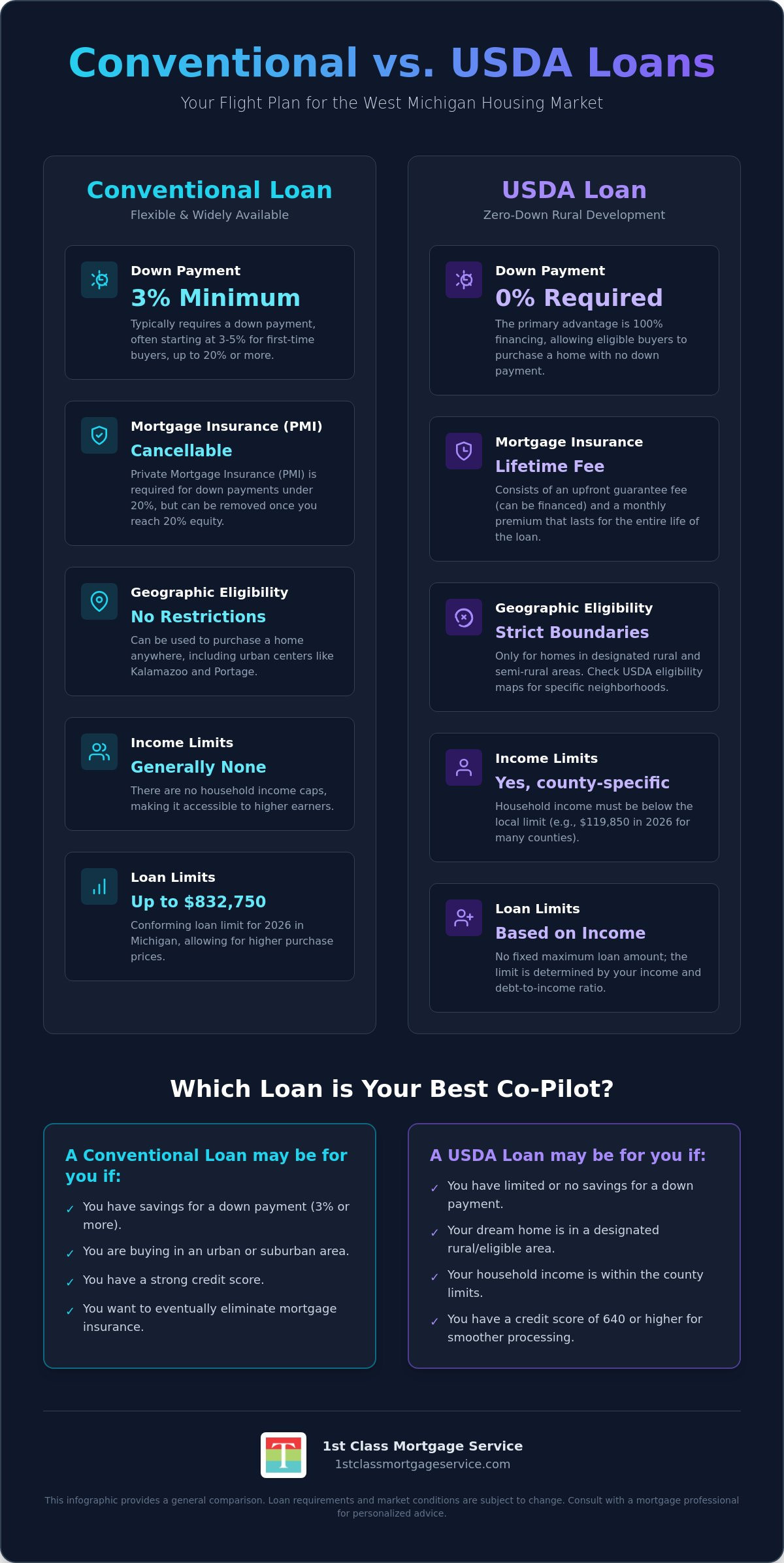
Direct Comparison: Conventional vs. USDA Loan Mechanics
To choose the right engine for your home purchase, you need to look under the hood at the mechanical specifications. Comparing a Conventional vs USDA Loan Michigan involves more than just looking at the sticker price. Each program has specific requirements for your down payment, insurance structure, and the property’s physical condition. Understanding these variables ensures your financial cargo remains secure throughout the duration of your flight.
- Down Payment: USDA offers 100% financing (0% down), while Conventional requires at least 3% for first-time buyers.
- Mortgage Insurance: USDA utilizes a 1% upfront guarantee fee plus a 0.35% annual fee. Conventional uses monthly PMI that disappears once you reach 20% equity.
- Loan Limits: Conventional follows a strict conforming limit of $832,750 in 2026. USDA has no set dollar limit but is restricted by your household income and debt-to-income ratio.
- Appraisal Standards: USDA appraisers follow strict “safety and soundness” guidelines, checking for items like peeling paint or missing handrails. Conventional appraisals focus primarily on fair market value.
The “Total Cost of Flight” Comparison
Calculating the break-even point is essential for long-term planning. While the USDA’s zero-down option is attractive, the 1% upfront guarantee fee is added to your initial loan balance, meaning you start your journey with slightly more debt than the home’s purchase price. Over time, the Conventional path often becomes more cost-effective because the PMI is temporary. If you’re leaning toward the Conventional route but need help with the initial lift, MSHDA Down Payment Assistance can act as a powerful booster. This program helps bridge the gap, allowing you to enjoy Conventional flexibility without a large cash reserve.
Credit Score and DTI Thresholds
Your credit score and Debt-to-Income (DTI) ratio determine your monthly “payload” capacity. To secure a Conventional loan, you generally need a minimum score of 620. The USDA path typically requires a 640 for automated approval, though it can be stricter regarding your total monthly debt obligations. Think of your credit score as tuning your engine; the higher it is, the more efficiently your loan performs. Before you commit to a specific path, it’s wise to compare your actual numbers with a local navigator who can run multiple scenarios for your West Michigan coordinates. This precision prevents unexpected turbulence when your application reaches the final underwriting stage.
Charting Your Course with a Local Navigator
Deciding between a Conventional vs USDA Loan Michigan shouldn’t feel like flying solo through a storm. While technical data provides the specifications for each engine, the actual execution requires a cockpit-level view of the West Michigan market. Jeremy Drobeck – Treadstone Mortgage has been navigating this local terrain since 2002, helping families in Kalamazoo, Portage, and Battle Creek find the perfect balance between upfront lift and long-term stability. A local guide understands that a house in Mattawan requires a different flight plan than a condo in downtown Kalamazoo. Whether you are pursuing a standard Purchase Mortgage or exploring specialized paths like Renovation Mortgages, having an ally who knows the local runway is essential for a smooth landing.
The MSHDA Advantage for Michigan Buyers
One of the most powerful tools available to Michigan residents is the MSHDA down payment assistance program. This is often the secret booster that makes the Conventional path viable for those who don’t have a massive cash reserve. You can use MSHDA to cover the 3% down payment required for a Conventional loan, effectively mimicking the zero-down benefit of a USDA loan without the geographic restrictions. While USDA loans already offer 100% financing, an expert at Jeremy Drobeck – Treadstone Mortgage can help you explore if state-specific programs can further reduce your closing costs. Navigating these state-level assistance programs requires a navigator who is specifically licensed and experienced with Michigan’s unique housing flight rules.
Preparing for Takeoff: Your Next Steps
The real estate market in Kalamazoo and Portage moves at high speed, and a generic pre-approval from a national lender often lacks the authority needed to win a competitive bid. Sellers in our community value local names they trust. To ensure your offer carries the necessary weight, follow this simple three-step flight check:
- Gather your flight logs: Organize your recent paystubs, W2s, and bank statements to provide a clear view of your financial cargo.
- Secure a 24-hour pre-approval: We commit to a fast turnaround, giving you the confidence to make an offer the moment you find the right coordinates.
- Consult your navigator: Schedule a personalized strategy session to run a final Conventional vs USDA Loan Michigan comparison based on your specific target address.
Don’t leave your homeownership journey to chance or automated algorithms. By partnering with Jeremy Drobeck – Treadstone Mortgage, you ensure that every part of your application is engineered for success. Contact our team today to build a personalized flight plan that gets you into your new West Michigan home with precision and care.
Ready for Takeoff: Secure Your West Michigan Home
Choosing the right engine for your homeownership journey requires a clear understanding of the Conventional vs USDA Loan Michigan landscape. Whether you prioritize the zero-down advantage of a rural development path or the unrestricted flexibility of a Conventional mortgage, your success depends on a flight plan tailored to your specific financial cargo. You’ve seen how income limits, geographic boundaries, and insurance mechanics impact your monthly costs. Now, it’s time to put that knowledge into motion.
Jeremy Drobeck – Treadstone Mortgage has served as a local Kalamazoo specialist since 2002, providing the expert guidance needed to navigate West Michigan’s unique terrain. As an MSHDA certified navigator and an expert in rural development programs, he ensures your application meets every technical requirement for a smooth landing. Don’t let the complexity of 2026 lending rules ground your dreams. Every milestone in your application process deserves the precision of a seasoned guide who knows the local runway.
Chart your mortgage flight plan with Jeremy Drobeck – Treadstone Mortgage today and take the first step toward your new front door. We are here to guide you through every mile of the process with precision, integrity, and neighborly care. Your journey home starts with the right navigator at your side.
Frequently Asked Questions
Is a USDA loan better than a Conventional loan for a first-time buyer in Michigan?
The best choice depends on your financial coordinates and where you plan to land. A USDA loan is often superior for those with limited savings because it allows for zero down payment in eligible rural areas. However, when comparing a Conventional vs USDA Loan Michigan, high-credit borrowers may prefer the Conventional path to avoid permanent government fees and gain the flexibility to buy in any neighborhood.
Can I buy a house in Kalamazoo city limits with a USDA loan?
Usually, you cannot use a USDA loan within the dense urban center of Kalamazoo. Most city centers are considered “ineligible” territory on the official maps. To utilize this zero-down program, you typically need to look toward the outskirts or surrounding communities like Vicksburg, Mattawan, or Schoolcraft. Checking your specific target coordinates with a local navigator is the only way to be certain before you make an offer.
What are the 2026 income limits for USDA loans in Kalamazoo County?
For 2026, the USDA income limit for a 1-4 member household in Kalamazoo County is $119,850. If your household has 5 or more members, that limit increases to $158,250. These figures represent the total income for everyone living in the home, not just the person on the mortgage. If your “payload” is slightly over these limits, certain deductions for childcare or medical expenses might help you qualify.
Do Conventional loans always require a 20% down payment?
Absolutely not, as many first-time buyers successfully reach takeoff with as little as 3% down. The 20% figure is simply the threshold required to avoid monthly mortgage insurance. If you have a clean flight record with your credit, the 3% down Conventional option is a highly competitive way to secure a home without draining your entire cash reserve for a larger down payment.
How does the USDA appraisal differ from a Conventional appraisal in Michigan?
A USDA appraisal is more rigorous regarding the physical safety and soundness of the property. The appraiser must ensure the home meets specific HUD standards, which includes checking for items like peeling paint, safe handrails, and functioning mechanical systems. Conventional appraisals focus primarily on the market value of the home and general condition, often making them a faster choice for homes that might need minor cosmetic repairs.
Can I use MSHDA down payment assistance with a Conventional mortgage?
Yes, MSHDA assistance is a powerful booster that can be paired with a Conventional mortgage to cover your down payment. This combination is popular in West Michigan because it allows you to buy a home anywhere in Kalamazoo or Portage with very little out-of-pocket cash. It effectively gives you the low-entry benefit of a government program with the standardized flexibility of a private-market Conventional loan.
Which loan type has a faster closing time in the West Michigan market?
Conventional loans generally offer a faster flight path to the closing table. Because they don’t require a secondary review by a government agency like the USDA, the underwriting process is more streamlined. In a competitive Conventional vs USDA Loan Michigan scenario, a seller might prefer a Conventional offer because it typically signals a quicker, more predictable journey to the final destination without extra government layers.
Does a USDA loan have PMI?
Technically, no, but it carries a different type of insurance fee. Instead of Private Mortgage Insurance (PMI), USDA loans utilize an upfront guarantee fee of 1% and an annual fee of 0.35%. While PMI on a Conventional loan can be cancelled once you reach 20% equity, the USDA annual fee typically stays with the loan for its entire duration. This is a critical factor to calculate when weighing your long-term monthly costs..



Latest Blog Post
S.O.S. SAVE OUR SALE
S.O.S. SAVE OUR SALE: WHAT TO DO WHEN YOUR LENDER STALLS WEEKS BEFORE CLOSING!
 Did your mortgage lender suddenly go radio silent, request the same bank statement for the fourth time, or drop a last-minute loan denial right before your scheduled closing date?
Yesterday, a panicked real estate agent called my office from Portage. Their buyer had been under contract for three weeks on a home near Milwood. The closing date sat just nine days away.
Out of nowhere, the buyer’s out-of-state call-center lender issued a denial letter. The call-center underwriter miscalculated self-employment write-offs, panicked over an unpermitted porch repair on the appraisal, and threw the entire transaction into the trash can.