
Refinance to Remove PMI in Michigan: Your 2026 Navigation Guide
What if your monthly mortgage payment was carrying over a hundred dollars of dead weight every single month? For many homeowners, private mortgage insurance feels like paying for a booster rocket that has already finished its job. You’ve likely watched your property value climb, with Michigan median prices rising 5.4 percent over the last year, yet you’re still paying for insurance that only protects the lender. It’s frustrating to feel like you’re throwing money away when your home equity has already reached that crucial 20 percent milestone.
Deciding to refinance to remove PMI Michigan is the mechanical adjustment many families need to maintain their financial momentum in 2026. This guide will teach you how to navigate the current 7.00 percent average interest rate environment against your potential monthly savings to see if a change is worth the flight. We’ll explore how to verify your current equity, calculate the break-even point on closing costs, and ultimately lower your monthly mortgage payment so you can keep more of your hard-earned income.
Key Takeaways
- Identify why the 20 percent equity threshold is the mechanical milestone for removing PMI and how Michigan’s recent home value growth helps you reach it faster.
- Discover why homeowners with FHA loans often must refinance to remove PMI Michigan because their original insurance premiums are designed to last for the life of the loan.
- Calculate your flight path to savings by identifying the breakeven point where your monthly mortgage reduction outweighs the initial investment of closing costs.
- Follow a clear, step-by-step navigation plan to assess your current loan-to-value ratio and determine if your home equity is ready for a professional adjustment.
- Understand the advantage of working with a local Kalamazoo navigator who provides personalized care and precise regional expertise instead of a national call center.
Understanding PMI in the 2026 Michigan Housing Market
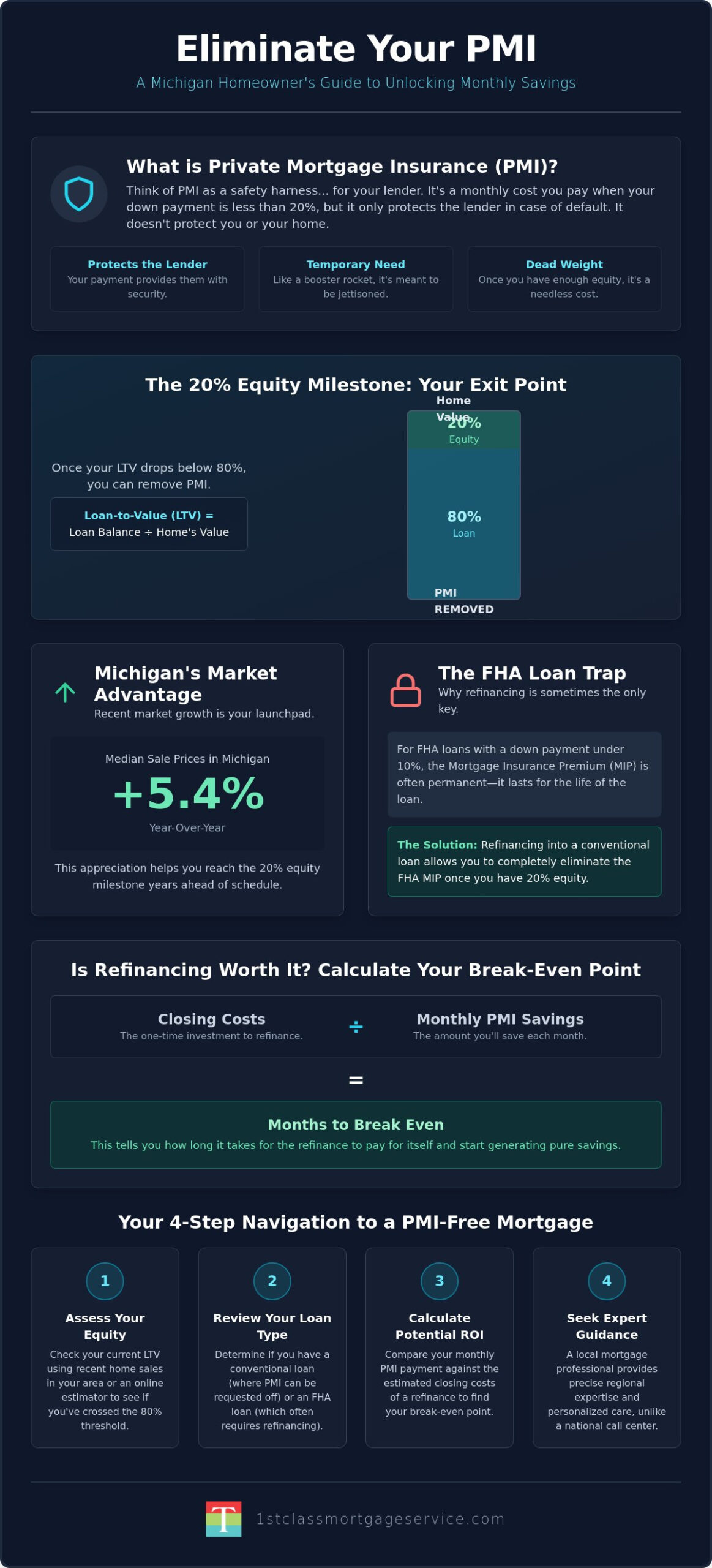
Think of Private Mortgage Insurance (PMI) as a safety harness for your lender. You pay the monthly premium, but they receive the protection. It is a standard requirement when your down payment is less than 20 percent of the home’s purchase price. While this tool helps many Michiganders enter the housing market sooner, it’s a monthly cost that eventually loses its utility once you have built sufficient equity. To truly grasp how this mechanical component affects your loan, Understanding Private Mortgage Insurance (PMI) is essential for any homeowner looking to optimize their monthly budget. Unlike homeowners insurance, which protects your physical structure, or title insurance, which protects your ownership rights, PMI only covers the lender if a default occurs. It is a temporary booster rocket; once you have reached a stable altitude, it is time to drop the extra weight.
The 80% LTV Milestone Explained
Every financial journey has a waypoint where the wind shifts in your favor. In the mortgage world, that waypoint is the 80 percent Loan-to-Value (LTV) ratio. Loan-to-Value is the ratio of your loan balance to the home’s appraised value. Think of LTV like the fuel gauge on a long flight. Once the needle drops below 80 percent, you have reached the altitude where you can safely jettison the extra weight of PMI. Michiganders should remember that “original value” refers to the price when you first bought the home, but “current value” is what matters most when you look to refinance to remove PMI Michigan. If your home has appreciated significantly, your current LTV might already be much lower than your original paperwork suggests. This distinction is vital because market growth can do the heavy lifting for you, effectively accelerating your path to a lower payment.
Why Michigan Homeowners are Shedding PMI Faster in 2026
The Michigan housing market has provided some serious lift over the last year. Median sale prices across the state were up 5.4 percent year-over-year in May 2026. In local hubs like Kalamazoo and Battle Creek, stable growth has helped many families cross the 20 percent equity line years ahead of schedule. When you combine this market appreciation with strategic home improvements, like a finished basement or a kitchen upgrade, your equity grows even faster. You don’t always need a formal appraisal to check your progress. Keeping an eye on recent sales in your neighborhood or using online valuation tools can give you a rough estimate of your current position. If similar homes in your area are selling for 10 percent more than they were two years ago, you might be ready to refinance to remove PMI Michigan and lock in a more efficient monthly payment. It’s about being proactive. Don’t wait for the lender to tell you that you’ve reached the milestone. They often won’t mention it until the balance hits 78 percent automatically, which could leave you paying for insurance you no longer need.
Why Refinancing is Often the Only Way to Remove PMI
While you can sometimes request a cancellation on a standard loan, many Michiganders find themselves in a holding pattern they can’t simply request their way out of. If you started your homeownership journey with an FHA loan and put down less than 10 percent, you are likely dealing with the “FHA Trap.” In this scenario, the Mortgage Insurance Premium (MIP) isn’t just a temporary phase; it’s often a permanent fixture for the life of the loan. According to the official definition of PMI, these payments exist to protect the lender, but for FHA borrowers, they can feel like a never-ending tax on your housing costs. To escape this, you must perform a full course correction. Choosing to refinance to remove PMI Michigan allows you to retire that FHA debt entirely and replace it with a new conventional structure where insurance is no longer required.
The 2026 interest rate environment adds a layer of complexity to this decision. With the average 30-year fixed rate in Michigan hovering around 7.00 percent in July 2026, you might hesitate to trade in a lower rate from a few years ago. However, the total monthly “flight cost” is what matters. If your monthly insurance premium is $150 or $200, your effective interest rate is actually much higher than what’s written on your note. Eliminating that insurance line item can often result in a lower total monthly payment, even if the new interest rate is slightly higher than your original one. It’s about looking at the total cost of the journey rather than just one single instrument on the dashboard.
FHA MIP vs. Conventional PMI
The primary difference between these two flight plans is how they handle insurance termination. FHA loans require MIP for the life of the loan if your initial down payment was low. In contrast, a Conventional Mortgage allows for the complete removal of PMI once you reach 20 percent equity. Transitioning to a conventional loan is often the superior long-term strategy, provided your credit score is in good health. A higher credit score not only helps you qualify for the refinance but also ensures you get the most efficient terms on your new, PMI-free loan. If you’re unsure where your equity stands, it’s a good time to start your equity review with a local expert.
The Appraisal: Your Ticket to PMI Removal
A new appraisal is the engine that powers your refinance. Since Michigan home prices have seen steady growth, with a 5.4 percent increase year-over-year as of May 2026, your Kalamazoo home might be worth significantly more than you think. Preparing for this valuation is crucial. Small touches, like tidying the landscaping or finishing minor repairs, can help ensure the appraiser sees the full value of your investment. If the appraisal comes in lower than expected, don’t panic. We can often look at alternative paths or wait for a bit more market lift before attempting the maneuver again. The goal is a precise valuation that reflects your true equity, giving you the clearance needed to drop PMI for good.
Calculating the ROI: Is the “Lift” Worth the Refinance Cost?
Before you commit to a new flight plan, you need to know if the fuel savings outweigh the cost of the takeoff. Calculating the Return on Investment (ROI) is the most critical step in deciding whether to refinance to remove PMI Michigan. You should look for the breakeven point, which is the specific month where your accumulated monthly savings finally exceed the upfront costs of the new loan. If you plan to stay in your Kalamazoo home for the next decade, a three year breakeven point is an easy win. However, if you are planning to move in eighteen months, the math might not clear the runway. It is also vital to understand your rights for PMI removal so you don’t spend money on a refinance if a simpler cancellation request is available to you.
The 2026 market presents a unique challenge with the average 30-year fixed rate sitting at 7.00 percent. When you check the current mortgage rates, you must account for the “reset” of your 30-year clock. Starting a new 30-year term can lower your payment, but it may increase the total interest paid over the life of the loan. A seasoned navigator will help you weigh this against the hidden benefits, such as the ability to remove escrow requirements. Once you have 20 percent equity, many conventional lenders allow you to manage your own property taxes and homeowners insurance, giving you total control over your monthly cash flow.
Estimating Your Monthly Savings
Typical PMI costs usually range from 0.5 percent to 1.5 percent of your total loan amount annually. On a $250,000 mortgage, that is a monthly “dead weight” of roughly $105 to $312. Removing a $200 monthly payment does more than just pad your bank account; it significantly improves your debt-to-income ratio, which can be a major advantage if you plan to apply for other credit in the future. Beyond the numbers, there is a profound psychological relief in knowing every dollar of your mortgage check is actually going toward your home or your interest, rather than a protective policy for the bank.
Understanding Refinance Closing Costs in Michigan
Every refinance requires an investment to get off the ground. These fees cover title insurance, recording your new deed with the county, and the lender’s origination costs. Closing costs in Michigan typically range from 2% to 5% of the loan amount. You might hear about “no-cost” refinances, but it is important to understand how these actually function. In these scenarios, the lender usually increases your interest rate slightly to cover the upfront fees. This might be a smart maneuver if you want to keep your cash in your pocket today, but it requires a careful calculation to ensure the long-term lift remains profitable. We specialize in analyzing these trade-offs to ensure your new flight path is as efficient as possible.
The Step-by-Step Navigation to a PMI-Free Mortgage
Transitioning to a more efficient mortgage structure requires a clear flight plan. While the mechanics of lending can feel complex, the path to a lower monthly payment is predictable when you follow a disciplined sequence. The journey to a leaner mortgage starts with a simple instrument check. Before you begin the formal application, follow these five essential steps to ensure your home is ready for takeoff.
- Step 1: Estimate your current Loan-to-Value (LTV). Review your most recent mortgage statement and compare your balance to the estimated market value of your home. With Michigan median home prices rising 5.4 percent year-over-year as of May 2026, you might find your equity has grown faster than your original amortization schedule predicted.
- Step 2: Review your existing flight plan. Determine if you have an FHA or Conventional loan. If you’re in an FHA loan with a low down payment, remember that a refinance to remove PMI Michigan is often the only way to jettison those permanent insurance premiums.
- Step 3: Partner with a local navigator. Consult with a Michigan mortgage expert to perform a pre-flight equity analysis. This professional review confirms if the numbers clear the runway for a profitable refinance.
- Step 4: Secure your 2026 rate. Once the math makes sense, you’ll lock in your interest rate and schedule the appraisal. In July 2026, the average 30-year fixed refinance APR in Michigan sits at approximately 6.621 percent, providing a stable baseline for your new payment.
- Step 5: Final approach and closing. After the appraisal confirms your equity, you’ll sign your final documents. The immediate result is the removal of the PMI line item, giving you a leaner monthly budget starting with your very first new payment.
If you are ready to see how much “lift” your current home equity can provide, schedule your pre-flight equity analysis today to explore your options.
Gathering Your Flight Documents
A smooth application process depends on preparation. You’ll need to gather your essential paperwork, including your most recent pay stubs, W2 forms, and your current mortgage statement. Having your original PMI disclosure form from your initial closing can also help your navigator speed up the verification process. Lenders look for stability, so maintaining a clean payment history with no late entries over the last 12 months is the best way to ensure your file stays on track for approval. Think of this documentation as your pre-flight manifest; the more accurate it is, the faster you’ll reach your destination.
Working with a Local Michigan Appraiser
The appraisal is the most critical component of your refinance engine. Working with a professional who understands the local nuances of markets like Portage or Battle Creek ensures your valuation is accurate and fair. When the appraiser arrives, be prepared to communicate any recent upgrades you’ve made to the property. Small repairs can provide a significant boost to your final valuation. Before your appointment, perform a “Homeowner Flight Check” by addressing minor issues like leaky faucets, peeling paint, or overgrown landscaping. These small investments of time can help ensure your home appraises at the value needed to successfully refinance to remove PMI Michigan and eliminate those insurance costs for good.
Why a Local Kalamazoo Navigator Makes the Difference
Choosing the right team is the difference between a turbulent flight and a smooth arrival. When you decide to refinance to remove PMI Michigan, you aren’t just looking for a competitive rate; you’re looking for a partner who understands the local landscape. National call centers often treat your mortgage like a data point on a spreadsheet. In contrast, Jeremy Drobeck and the Treadstone team view your home as a vital part of the Kalamazoo community. We believe in individualized care and respect, shifting the experience from a cold transaction to a supportive partnership. Our commitment is simple: we stay present from the very first equity review to the final signature at the closing table.
A refinance is a significant life milestone. It represents your transition from the entry phase of homeownership into a period of long term financial stability. By shedding the extra weight of insurance premiums, you’re effectively recalibrating your household budget for better performance. This isn’t just about paperwork; it’s about securing your family’s future in West Michigan. We take that responsibility seriously, providing the steady, expert guidance needed to lower the stress barriers associated with major financial commitments.
Expertise in West Michigan Lending
Our deep roots in the region give us a unique vantage point. We understand the nuances of local markets because we live and work here too. Whether we are helping a first time buyer with Purchase Mortgages or assisting a long term homeowner with a complex refinance, we handle every scenario with precision. We specialize in those unconventional situations that might baffle a national lender. Our “Neighborly Reassurance” promise means you won’t deal with confusing jargon. You’ll get clear paths forward and a steady, reliable ally who handles the mechanical details so you can focus on the journey.
Ready for Takeoff? Your Next Steps
Your home equity is your fuel, and it’s time to use it to your advantage. We invite you to reach out for a no-obligation equity review to see if the timing is right for your financial flight. You can contact our team in Kalamazoo, Portage, or Battle Creek to start the conversation. Don’t let your monthly payments stay weighed down by insurance you no longer need. If you’re ready to refinance to remove PMI Michigan, we are here to provide the expert guidance and calm navigation you deserve. Let’s get your mortgage into a more efficient gear today.
Take Control of Your Financial Flight Path
You have worked hard to build equity in your home, and the 2026 market has likely given you the lift you need to reach the 20 percent milestone. Whether you’re currently dealing with a permanent FHA insurance premium or simply waiting for your conventional loan to catch up with rising property values, the path forward is clear. Choosing to refinance to remove PMI Michigan isn’t just a paperwork adjustment; it’s a strategic maneuver that can put significant funds back into your monthly budget starting with your very next payment.
You don’t have to navigate these technical waters alone. With over 20 years of West Michigan mortgage expertise, our team provides the neighborly reassurance and professional precision required for a successful transition. We are a division of Neighborhood Loans, Inc. (NMLS #222982), and we maintain local offices in Kalamazoo and Portage to provide face-to-face guidance throughout your journey. We pride ourselves on being present from the first consultation to the final signature.
Ready to see what your home is truly worth? Schedule Your 2026 Equity Review with Jeremy Drobeck today. Your equity is the fuel for your next financial milestone, and we’re honored to be your steady, reliable ally every step of the way.
Frequently Asked Questions
Do I have to refinance to get rid of PMI in Michigan?
You don’t always need a full refinance if you have a conventional loan. You can request cancellation once your balance reaches 80 percent of the original value, or wait for automatic termination at 78 percent. However, if you are relying on the 5.4 percent market appreciation Michigan saw in 2026 to reach that milestone, a refinance is often the only way to prove your new equity level to the lender and jettison the insurance cost early.
What is the minimum credit score needed to refinance and remove PMI?
Most conventional flight plans require a minimum credit score of 620. While you can qualify at that level, higher scores provide much better lift for your interest rate and overall savings. Aiming for a score of 740 or above typically unlocks the most efficient terms, making the transition from an FHA loan to a conventional mortgage even more profitable for your monthly budget.
How much equity do I really need to stop paying mortgage insurance?
The magic number is 20 percent equity. This means your loan balance must be 80 percent or less of the home’s current appraised value. When you refinance to remove PMI Michigan, a professional appraiser confirms your home’s value to ensure you’ve cleared this threshold. Reaching this waypoint allows you to stop paying for lender protection and start keeping that cash in your own pocket.
Can I remove PMI from an FHA loan without refinancing?
For most FHA borrowers who put down less than 10 percent, the answer is no. FHA guidelines typically require Mortgage Insurance Premiums (MIP) for the entire life of the loan. The only way to escape this “FHA trap” is to refinance to remove PMI Michigan by moving into a conventional mortgage. This maneuver allows you to leave the permanent FHA premiums behind once your home equity reaches the 20 percent mark.
How long does the refinance process typically take in 2026?
A standard refinance journey usually takes between 30 and 45 days from your initial application to the final signature. This timeline includes the time needed for a local appraiser to visit your home and for the underwriting team to verify your flight documents. We remain your steady ally throughout this duration, ensuring each step of the navigation is handled with precision and transparency.
What happens if my home appraisal comes in lower than 20% equity?
If the appraisal doesn’t reach the 20 percent milestone, you have a few options to stay on course. You can choose to bring cash to the closing table to pay down the balance to 80 percent LTV, or you can wait for further market appreciation. We help you run the numbers before the appraisal to minimize the risk of a low valuation and ensure your flight plan is realistic.
Will refinancing to remove PMI increase my interest rate?
It is possible your interest rate will increase if your current rate is below the July 2026 average of 7.00 percent. However, the goal is to lower your total monthly flight cost. If removing a $250 monthly PMI payment saves you more than the higher interest rate costs you, the refinance is still a successful financial maneuver. We focus on your total monthly savings rather than just the interest rate instrument.
Are there specific Michigan programs that help with refinancing costs?
While programs like MSHDA focus primarily on purchase assistance, many Michiganders use a “no-cost” refinance to manage upfront expenses. In this scenario, the closing costs are covered by a slightly higher interest rate, allowing you to refinance without a large out of pocket investment. We analyze these trade-offs with you to determine which mechanical adjustment provides the best long term momentum for your household.



Latest Blog Post
S.O.S. SAVE OUR SALE
S.O.S. SAVE OUR SALE: WHAT TO DO WHEN YOUR LENDER STALLS WEEKS BEFORE CLOSING!
 Did your mortgage lender suddenly go radio silent, request the same bank statement for the fourth time, or drop a last-minute loan denial right before your scheduled closing date?
Yesterday, a panicked real estate agent called my office from Portage. Their buyer had been under contract for three weeks on a home near Milwood. The closing date sat just nine days away.
Out of nowhere, the buyer’s out-of-state call-center lender issued a denial letter. The call-center underwriter miscalculated self-employment write-offs, panicked over an unpermitted porch repair on the appraisal, and threw the entire transaction into the trash can.