Getting a Mortgage with Student Loan Debt in Michigan: Your 2026 Flight Plan
What if your student loan balance wasn’t an anchor holding you back, but simply a coordinate on your flight plan toward a new front door? Many aspiring homeowners believe that getting a mortgage with student loan debt in Michigan is impossible, especially with the average federal balance hovering around $38,375 in 2026. It’s natural to feel anxious when big banks focus solely on your debt-to-income ratio, often ignoring the reality of your financial potential and your career trajectory.
We understand that the path to homeownership in Kalamazoo or Portage can feel turbulent when you’re managing monthly loan payments alongside rising costs. This guide will show you how to navigate the current lending landscape, where even a $0 income-driven payment can be used to your advantage under specific FHA and Conventional guidelines. You’ll learn how to leverage Michigan-specific assistance programs, like MSHDA’s $10,000 down payment support, to gain the necessary lift for a successful closing. We’re going to break down the precise math lenders use and plot a clear course for you to secure a home loan without the fear of rejection.
Key Takeaways
- Understand why your total loan balance isn’t an anchor; lenders prioritize your monthly repayment velocity over the size of the debt.
- Master the specific DTI calculations for FHA and Conventional loans to streamline your path toward getting a mortgage with student loan debt in Michigan.
- Leverage Income-Driven Repayment plans to lower your debt coordinates and satisfy strict lender requirements.
- Unlock Michigan-specific assistance like MSHDA programs that provide the extra lift needed to reach your closing goals.
- Learn the exact steps to prepare your financial flight deck for a professional analysis from a local mortgage expert.
Does Student Loan Debt Block Your Path to a Michigan Home?
Many Michigan graduates feel like their student loan balance is a storm cloud blocking their visibility. They assume a high balance means an automatic rejection. This is a common misconception that keeps many qualified people in the rental market. The truth is that getting a mortgage with student loan debt in Michigan is a structured process, not a gamble. Lenders aren’t looking for a zero balance; they are looking for a stable flight path.
Your student debt is simply one coordinate in your total Debt-to-income ratio. In 2026, mortgage guidelines have become significantly more sophisticated in how they view these loans. Instead of seeing a massive total amount as an immovable barrier, underwriters now look at the monthly mechanical impact on your cash flow. This shift is vital for anyone getting a mortgage with student loan debt in Michigan, as it focuses on your current ability to manage a monthly payment rather than a legacy balance from your education.
The “Weight” vs. The “Flight”: Balance vs. Payment
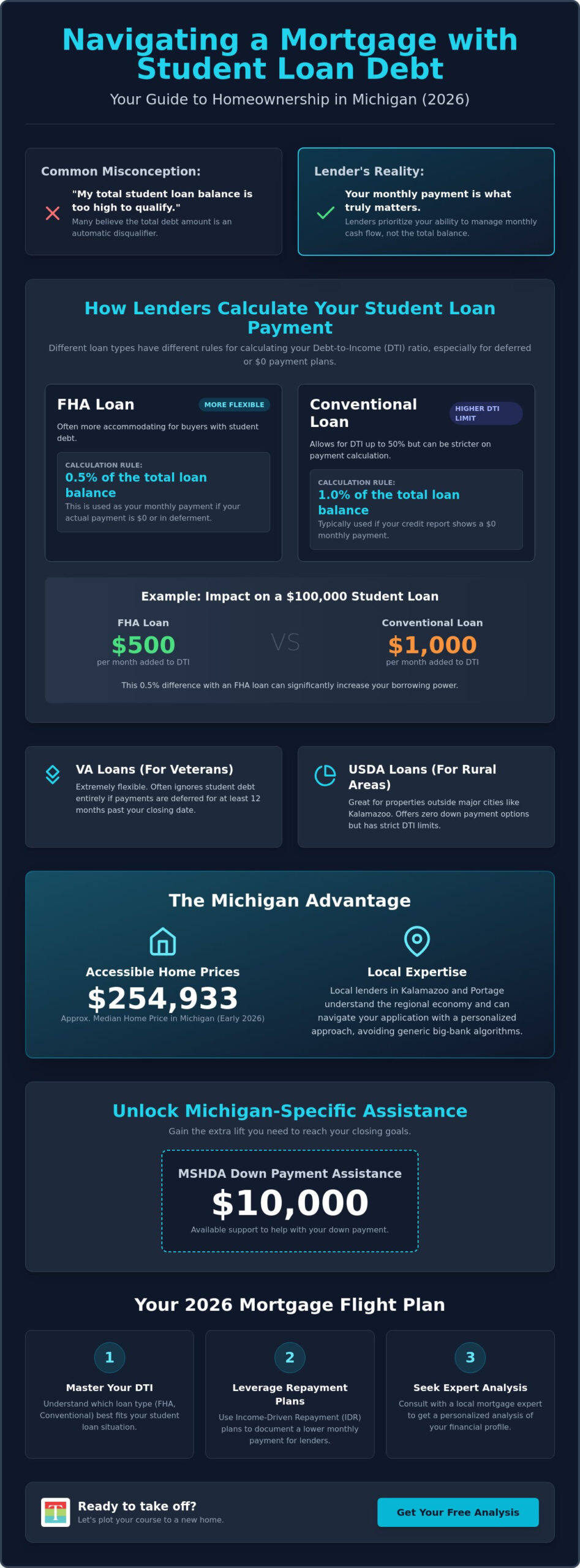
Underwriters care about your “thrust” versus your “drag.” The total six-figure balance on your credit report is the weight, but the monthly payment is the drag. For example, if you have $100,000 in debt but a documented Income-Driven Repayment plan that sets your payment at $150, that $150 is the figure used to calculate your eligibility. If your loans are in a deferred status, 2026 rules typically require lenders to use a small percentage of the balance, like 0.5% for FHA loans, to simulate the payment. This is a far cry from the restrictive rules of the past. Your degree isn’t just debt; it’s the engine that provides the income lift needed to sustain a home loan over the long term.
Why Michigan Buyers Have a Unique Advantage
The West Michigan housing market remains remarkably resilient. While national headlines might sound turbulent, the local landscape in Kalamazoo and Portage offers a sense of stability. Median home prices in Michigan were approximately $254,933 in early 2026, which is often more accessible for debt-holders than coastal markets. Local lenders understand the regional economy and the specific assistance programs available to our neighbors. This local expertise allows for a more personalized navigation of your application, ensuring you don’t get grounded by generic, big-bank algorithms that don’t understand the Michigan market’s unique lift. We view your application through a lens of neighborly reassurance, helping you find a path to homeownership that balances your past education with your future goals.
Navigating DTI: How Different Loan Types Treat Student Debt
Your Debt-to-Income (DTI) ratio serves as the primary set of coordinates for your financial flight plan. Lenders look at two specific numbers: your front-end ratio, which covers your projected housing costs, and your back-end ratio, which encompasses all monthly obligations like car loans and credit cards. According to the Consumer Financial Protection Bureau, having student debt doesn’t disqualify you, but it changes how your “available thrust” is measured. For those getting a mortgage with student loan debt in Michigan, the specific loan type you choose determines how that debt is weighted against your income.
FHA vs. Conventional: Choosing Your Route
Choosing between an FHA or Conventional loan is like selecting between two different flight altitudes. For a Conventional loan in 2026, Fannie Mae guidelines typically allow for a DTI up to 50%, but they may use 1% of your loan balance as a payment placeholder if your credit report shows a $0 monthly obligation. However, FHA loans in Michigan are often more accommodating for those in deferment, as they generally use only 0.5% of the balance to calculate your monthly obligation. This 0.5% difference might seem small, but it can significantly increase your borrowing power when you’re looking for a home in a competitive market like Portage.
VA and USDA mortgages offer specialized paths that are often overlooked by national lenders. VA loans are notoriously flexible, frequently ignoring deferred student debt entirely if the deferment period extends at least 12 months beyond the closing date. USDA loans, which are excellent for properties in the more rural stretches surrounding Kalamazoo, follow strict DTI limits but allow for zero down payment. These programs provide a steady glide path for veterans and rural buyers who might otherwise struggle with the high “drag” of student loan payments on a traditional application.
Medical Professional & Specialized Loan Programs
Healthcare professionals in West Michigan often carry debt loads that would ground a standard application. Thankfully, specific programs allow for the exclusion of student loans from DTI if they are being paid by an employer or if you are within a residency period. Doctor Loans bypass traditional DTI constraints by allowing lenders to utilize your future employment contract as proof of income lift while frequently ignoring the student debt balance altogether. If you’re unsure which route fits your specific financial coordinates, it’s helpful to consult with a local Michigan lender who understands these nuances.
Strategies to Lower Your Monthly Payment Coordinates
Getting a mortgage with student loan debt in Michigan requires more than just a good credit score; it requires tactical adjustments to your monthly debt obligations. If your total loan balance feels like a heavy cargo load, your primary goal is to reduce the “drag” that monthly payments create on your debt-to-income ratio. By lowering these individual coordinates, you create the necessary clearance to qualify for a higher home purchase price without needing to pay off the debt in full. This is a maneuver that focuses on immediate cash flow rather than long-term liability.
Income-Driven Repayment (IDR) plans are the most effective tools for this adjustment. These plans calculate your monthly student loan payment based on your discretionary income rather than the total amount you owe. In many cases, this can result in a monthly obligation as low as $0 or $50. While national lenders might struggle with these unconventional figures, local experts know how to document these payments to satisfy strict underwriting requirements. While managing these monthly figures, you can also explore resources from the Michigan State Housing Development Authority (MSHDA) to see how state-level programs provide additional financial stability for your journey.
Leveraging IDR Plans for Maximum Borrowing Power
A $0 monthly payment on a $50,000 student loan balance might sound like a glitch, but for a mortgage underwriter, it’s a valid coordinate if documented correctly. To use this to your advantage, you must provide your lender with the official IDR approval letter from your loan servicer. This document must clearly state your calculated payment and the date your plan is set to expire. It’s best to transition to an IDR plan at least 60 days before you start your home search. This allows enough time for the new payment to be reflected in your records, ensuring your flight deck is clear for a pre-approval.
Consolidation and Refinancing Risks
Consolidating your loans can sometimes stabilize your flight path by combining multiple high-interest payments into one manageable monthly obligation. However, it can also be a double-edged sword. Opening new credit lines or consolidating debt mid-process can cause your credit score to dip temporarily, which might impact your mortgage interest rate. It’s vital to avoid any major debt changes without consulting a seasoned navigator like Jeremy Drobeck – Treadstone Mortgage. We can help you determine if a consolidation will provide the “lift” you need or if it will create unnecessary turbulence during your application. If a change is made, we utilize a “Credit Supplement” process to update your credit report in real-time, reflecting your new, lower payments immediately so your closing stays on schedule.
Michigan-Specific Solutions: MSHDA and Down Payment Assistance
While managing the drag of monthly student loan payments, saving for a substantial down payment can feel like an impossible climb. When a large portion of your monthly income is allocated toward education debt, your ability to accumulate liquid cash is naturally restricted. This is where getting a mortgage with student loan debt in Michigan becomes significantly easier through the use of state-specific stability mechanisms. Instead of waiting years to save for a traditional down payment, you can utilize programs designed to provide the necessary lift right now.
The Michigan State Housing Development Authority (MSHDA) offers specialized tools that offset the financial burden of student loans. By providing upfront capital, these programs allow you to keep your personal cash reserves high. Lenders often view these reserves as a safety net; having extra money in the bank after closing suggests you can handle financial turbulence even with a high debt-to-income ratio. This strategic approach transforms your application from a high-risk gamble into a well-engineered flight plan.
MSHDA: Your Stability Mechanism
In 2026, the MI Home Loan program remains a vital resource for West Michigan residents. It provides up to $10,000 in down payment assistance, which functions as a zero-interest, zero-monthly-payment loan. This assistance is only repaid when you sell the home or refinance the mortgage. To qualify, you generally need a minimum credit score of 640, though some conventional options require a 660. By leveraging Michigan First Time Home Buyer Programs, you reduce the initial “thrust” required from your own pocket, making homeownership attainable even while you’re still paying off your degree.
The Kalamazoo Advantage: Local DPA Programs
Kalamazoo, Portage, and Battle Creek residents have access to unique regional advantages that national lenders frequently overlook. Certain neighborhoods in these cities are designated as “targeted areas,” which can sometimes waive the first-time buyer requirement or offer higher income limits for assistance. Combining state-level MSHDA support with local city-level grants can create powerful momentum for your purchase. Local expertise in West Michigan programs is the key to approval, as we understand how to layer these benefits to maximize your borrowing power. If you want to see which specific coordinates of assistance are available for your target neighborhood, you can check your eligibility for MSHDA Down Payment Assistance with our team. We are committed to staying by your side through every stage of the application, ensuring you have the expert guidance needed to secure your Michigan home.
Your 2026 Mortgage Flight Plan: Next Steps to Closing
Plotting a course for homeownership requires more than just a destination; it requires a disciplined checklist of pre-flight actions. When you’re getting a mortgage with student loan debt in Michigan, your preparation determines how smoothly you’ll transition from applicant to homeowner. Following a specific sequence of steps ensures that your financial coordinates are locked in before you ever set foot in an open house in Portage or Battle Creek. We view this process as a partnership, where our technical expertise provides the engine and your preparation provides the fuel.
- Step 1: Gather your flight logs. Download your most recent student loan statements and, crucially, your official Income-Driven Repayment (IDR) plan approval letters. These documents are the primary evidence underwriters use to calculate your debt drag.
- Step 2: Request a professional DTI analysis. Don’t rely on online calculators that use generic formulas. A local Michigan expert can look at your specific debt structure to find the “lift” that national algorithms often miss.
- Step 3: Secure a Pre-Approval. This is your official clearance to fly. It accounts for your specific debt structure and gives sellers confidence that your financing is engineered for success.
- Step 4: Identify your target neighborhoods. Whether you’re looking at the family-friendly streets of Portage or the historic charm of Battle Creek, knowing your local coordinates helps us align your loan program with specific regional grants.
- Step 5: Close with confidence. With your navigator handling the technical details and constant availability, you can focus on the milestone of moving into your new home.
The Importance of a Local Navigator
Big-box online lenders often fail buyers with complex debt because they rely on rigid, automated systems. They see a high student loan balance and immediately pull the throttle back, assuming you’re a risk. Having Jeremy Drobeck – Treadstone Mortgage in your corner provides the individualized care and technical proficiency needed to navigate unconventional scenarios. We understand the neighborly nuances of the West Michigan market and how to present your file to underwriters as a success story rather than a statistic. For more detailed local insights, consider Navigating Your Purchase Mortgage in Kalamazoo to refine your search strategy.
Pre-Approval: Your Flight Clearance
In a competitive market, there’s a massive difference between a “guess” and a “guarantee.” A generic pre-qualification is just a preliminary scan, but a true pre-approval is a deep-dive analysis of your financial engine. We present your file to underwriters by emphasizing your income stability and career trajectory, effectively neutralizing the perceived weight of your student debt. This preparation ensures that when you find the perfect home, your offer carries the weight of a fully vetted financial plan. Ready to start your flight plan? Contact Jeremy Drobeck – Treadstone Mortgage today to secure your path to homeownership and begin your journey with a steady, reliable ally.
Take Command of Your Homeownership Flight Path
Your student debt doesn’t have to be the weight that keeps your homeownership dreams from taking flight. By understanding how modern underwriters view monthly payments and leveraging the lift provided by MSHDA Down Payment Assistance, you can navigate the 2026 market with total confidence. Whether you’re targeting a neighborhood in Kalamazoo or Portage, the right coordinates make all the difference in your success. Getting a mortgage with student loan debt in Michigan is a structured engineering process; it’s not a hurdle that should keep you grounded in the rental market.
We specialize in Conventional, FHA, and VA loans, ensuring your specific debt structure is matched with the ideal program for your goals. As experts in MSHDA programs with deep local expertise in West Michigan, we provide the precision and neighborly reassurance you need to reach your destination. You deserve a steady ally who is present through every mile of the journey, ensuring no detail is overlooked. We’ve helped many of your neighbors in Battle Creek and beyond turn their degrees into assets rather than liabilities.
Begin your homeownership flight plan with Jeremy Drobeck – Treadstone Mortgage today. Let’s clear the turbulence and secure your future home together.
Frequently Asked Questions
Can I get a mortgage in Michigan if my student loans are in deferment?
Yes, you can qualify while in deferment, but lenders won’t ignore the debt entirely. Instead, underwriters apply a placeholder payment, typically 0.5% of the total balance for FHA loans or 1% for some Conventional products. This ensures your financial flight plan accounts for future obligations. Getting a mortgage with student loan debt in Michigan while in deferment simply requires a more precise calculation of your debt-to-income coordinates to ensure a safe landing at closing.
How does my student loan payment affect my debt-to-income (DTI) ratio?
Your student loan payment is treated as a recurring monthly obligation that reduces your “available thrust” or borrowing power. Lenders calculate your DTI by adding your student loan payment to other monthly debts and dividing by your gross income. A lower monthly payment, even on a high total balance, improves your ratio. This calculation determines the maximum altitude of your home purchase price and ensures you don’t overextend your financial engine.
What is the minimum credit score needed to buy a house in Michigan with student debt?
You generally need a minimum credit score of 640 to access the most popular state assistance programs. If you are pursuing a Conventional Mortgage, many lenders prefer a score of 660 or higher to ensure the best interest rates. Maintaining a steady credit score is like keeping your flight deck clear of debris; it allows for a smoother approval process and provides more options for navigating around high student debt levels.
Are there special mortgage programs for teachers or nurses with student loans in Kalamazoo?
Teachers and nurses in Kalamazoo and Portage often qualify for “targeted area” benefits through state programs. These specialized paths may offer higher income limits or waive first-time buyer requirements. Additionally, some professional mortgage products allow healthcare workers to exclude certain debts if they are employer-paid. These programs provide the extra lift needed for professionals who provide essential services to our West Michigan community while carrying significant educational debt.
Can I use MSHDA down payment assistance if I have significant student debt?
Yes, MSHDA down payment assistance is a powerful stability mechanism for buyers with high student debt. By providing up to $10,000 in upfront capital, the program allows you to keep your personal savings as a safety net. This is particularly helpful when getting a mortgage with student loan debt in Michigan, as it offsets the “drag” of your monthly payments by reducing the initial cash required to clear the runway for homeownership.
What happens if my student loan payment is $0 on an Income-Driven Repayment plan?
A $0 payment on an Income-Driven Repayment (IDR) plan is often accepted as your qualifying payment for FHA and many Conventional loans. You must provide the official IDR approval letter from your servicer to document this coordinate. This rule is a major advantage for Michigan buyers, as it allows your actual cash flow to dictate your borrowing power rather than an arbitrary percentage of your total loan balance.
Should I pay off my student loans or save for a down payment first?
In many cases, saving for a down payment or utilizing assistance programs is more strategic than paying off student loans. Depleting your cash reserves can leave you with no safety net during your flight toward homeownership. If your monthly student loan payment is manageable, keeping your cash for a down payment or “reserves” often makes your application look stronger to underwriters than having slightly less debt but zero liquidity.
How do I document my student loan payments for a mortgage application?
You must gather your most recent billing statement and your official repayment plan documentation. If you’re on an IDR plan, the letter must show your current payment amount and the plan’s expiration date. Proper documentation is like a pre-flight inspection; it prevents delays and ensures your navigator has all the necessary data to present a clear, accurate file to the underwriting team for final clearance.



Latest Blog Post
S.O.S. SAVE OUR SALE
S.O.S. SAVE OUR SALE: WHAT TO DO WHEN YOUR LENDER STALLS WEEKS BEFORE CLOSING!
 Did your mortgage lender suddenly go radio silent, request the same bank statement for the fourth time, or drop a last-minute loan denial right before your scheduled closing date?
Yesterday, a panicked real estate agent called my office from Portage. Their buyer had been under contract for three weeks on a home near Milwood. The closing date sat just nine days away.
Out of nowhere, the buyer’s out-of-state call-center lender issued a denial letter. The call-center underwriter miscalculated self-employment write-offs, panicked over an unpermitted porch repair on the appraisal, and threw the entire transaction into the trash can.