How to Qualify for a DSCR Loan in Michigan: Your 2026 Investor Guide
What if your tax returns were the least important part of your next real estate acquisition? It sounds counterintuitive, but for savvy investors looking at the Michigan market, your personal debt-to-income ratio doesn’t have to be the weight that keeps your portfolio grounded. You’ve likely felt the frustration of a traditional bank stalling your progress because your complex tax filings hide your actual wealth, or perhaps high DTI ratios are blocking your path to a new property in Grand Rapids or Detroit.
We understand that you need a steady ally who treats your investments like a flight plan rather than just a stack of paperwork. In this guide, you will learn exactly how to qualify for a DSCR loan in Michigan by shifting the focus from your personal income to the property’s cash flow momentum. We will walk through the specific 2026 requirements, including the necessary 620 credit score and the math behind the ratio, to help you scale your holdings with the precision of a seasoned navigator while keeping your personal and business finances clearly separated.
Key Takeaways
- Learn exactly how to qualify for a DSCR loan in Michigan by shifting the underwriting focus from your personal tax returns to the property’s projected rental income.
- Understand the credit requirements needed to gain maximum “lift,” where a score of 720 or higher often unlocks the most competitive interest rates and terms.
- Master the ratio math by calculating the relationship between gross monthly rent and the total PITIA to ensure your investment generates enough momentum to cover its own debt.
- Explore unique Michigan market opportunities in areas like Kalamazoo and Battle Creek that offer strong potential for steady, cash-flowing rental portfolios.
- Prepare for a successful takeoff by identifying a target property and partnering with a seasoned local navigator to run preliminary numbers before you commit.
What is a DSCR Loan? Navigating Your Investment Flight Plan
Think of your real estate journey as a cross-country flight. In a traditional mortgage, you are the engine. The bank scrutinizes your personal fuel levels, your history as a pilot, and your personal cargo. But What is a DSCR Loan? It’s a shift in financial mechanics. With a Debt Service Coverage Ratio (DSCR) loan, the property itself becomes the engine providing the lift. Your personal tax returns and employment history stay on the ground as part of the support crew. The lender focuses almost entirely on the income the property generates to cover its own debt. This means your personal finances provide the stability, but the property’s cash flow provides the momentum.
Understanding how to qualify for a DSCR loan in Michigan starts with this fundamental shift in perspective. This specialized financing is ideal for single-family rentals, 2-4 unit multi-family properties, and even certain condos. Because there’s no personal debt-to-income (DTI) check, you aren’t limited by your personal paycheck or existing mortgage debt. It’s about the property’s ability to fly on its own merit.
DSCR vs. Conventional Mortgages
Traditional loans look at your W2s and tax returns; they want to know how much you earn at your day job. A DSCR loan looks at the lease agreement or the market rent. It’s a fast track for scaling your portfolio because you won’t hit the DTI ceilings that often stop investors after their third or fourth conventional acquisition. While you might see slightly higher interest rates compared to a primary residence loan, the trade-off is the significant flexibility to move quickly. You are essentially paying for the ability to bypass the friction of traditional income verification, allowing you to acquire more units in a shorter timeframe without the turbulence of complex paperwork.
Why Michigan Investors are Switching to DSCR in 2026
The 2026 Michigan rental market is showing remarkable stability, particularly in areas with a steady tenant base like those near major universities or healthcare hubs. In competitive hubs like Kalamazoo and Portage, speed is your greatest asset. DSCR loans allow for quicker closings because the underwriting process is streamlined. You aren’t waiting for a deep dive into five years of business tax returns that might not even reflect your true liquidity. Understanding how to qualify for a DSCR loan in Michigan gives you a distinct advantage in these local markets. For a deeper look at the current landscape, check out our DSCR Loan Guide 2026. This approach lets you secure properties while others are still hunting for their W2s, ensuring you don’t miss out on high-yield opportunities in Battle Creek or Grand Rapids.
Key Requirements to Qualify for a Michigan DSCR Loan
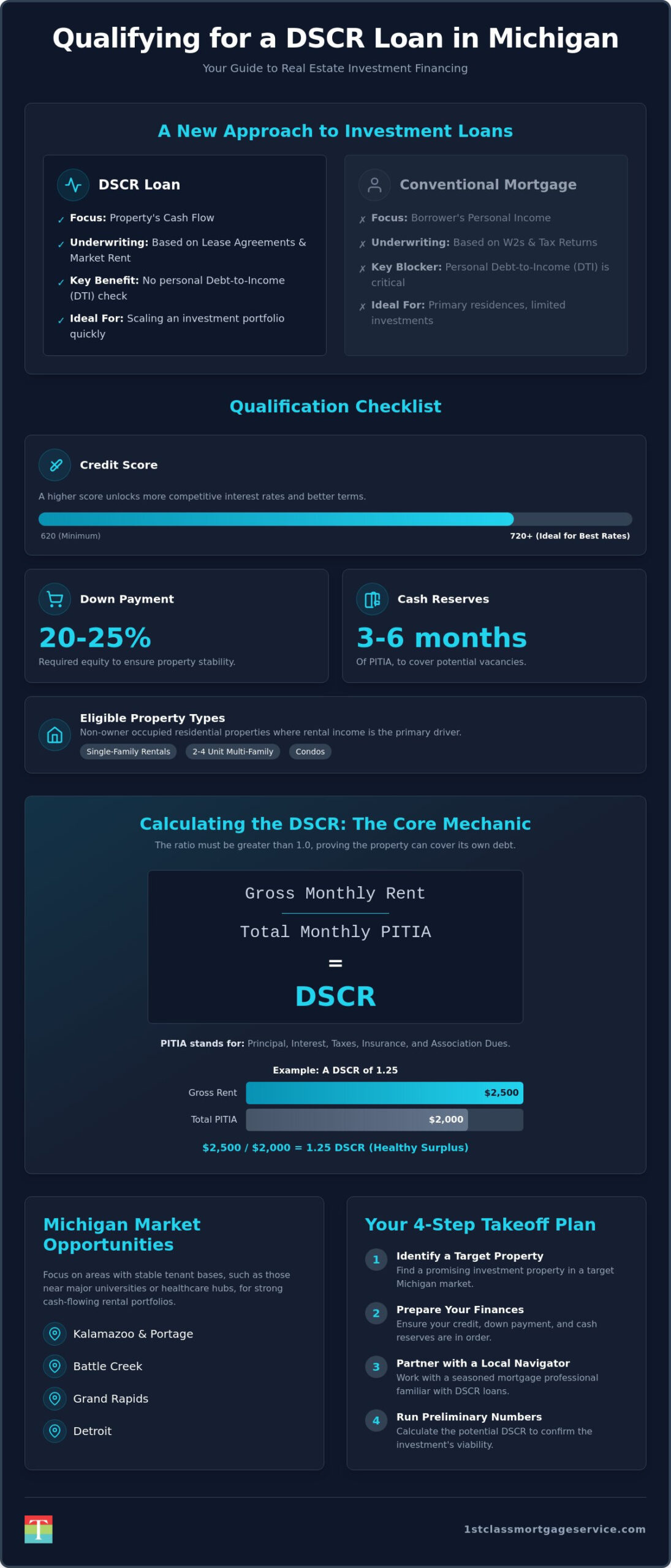
Preparing for takeoff requires a clear checklist. To understand how to qualify for a DSCR loan in Michigan, you first need to look at your credit score. While a 660 is often the baseline to get your wheels off the ground, a score of 720 or higher acts like a tailwind. This higher tier unlocks the most competitive interest rates and lowers your overall costs. You’ll also need to prepare for a down payment in the 20% to 25% range. This equity ensures the property has enough stability to weather any market turbulence while providing the lender with the security they need to approve the flight plan.
Lenders also look for an emergency parachute in the form of cash reserves. Typically, you’ll need three to six months of PITIA (Principal, Interest, Taxes, Insurance, and Association dues) sitting in a liquid account. This proves you can maintain the property even during a temporary vacancy. These loans are specifically designed for non-owner occupied residential properties. They focus on one to four unit buildings where the rental income is the primary driver of the deal. If you are looking to expand into the Kalamazoo or Battle Creek markets, having these reserves ready is a vital step in the process.
The Experience Factor: New vs. Seasoned Investors
Many believe you need years of experience to enter this space. That’s a common misconception. While seasoned investors find the process smoother, first-time investors can often secure a DSCR loan if the property’s projected income is strong enough. If you’re a newcomer, having a professional property management plan in place can reassure lenders that the investment will be handled with expert care. It’s about the strength of the asset, not just the length of your resume.
Asset and Income Documentation (The “No-Income” Path)
The “no-income” path is often misunderstood. It doesn’t mean the lender ignores income entirely; it means they ignore your personal paycheck. Instead of W2s, you’ll provide lease agreements and a 1007 Rent Schedule, which is a professional appraisal of what the property should earn. Providing these documents is the core of how to qualify for a DSCR loan in Michigan without the friction of a traditional bank. These are “No-QM” loans, serving as a specialized financial tool built specifically for entrepreneurs who value speed and efficiency over traditional red tape.
Calculating the Ratio: The Mechanics of Financial Momentum
In the world of investment lending, the ratio is your altimeter. It tells the lender exactly how much lift the property generates relative to the weight of its debt. The Debt Service Coverage Ratio (DSCR) is calculated by taking the gross monthly rent and dividing it by the monthly PITIA. For those wondering how to qualify for a DSCR loan in Michigan, understanding this specific math is the first step toward a successful closing. If your property brings in $2,000 a month and the total debt payment is $1,600, your ratio is 1.25. This means the property isn’t just hovering; it’s climbing with a 25% cushion of safety.
What exactly makes up the weight of that debt? We use the acronym PITIA to capture the full scope of your monthly obligations:
- Principal: The core repayment of the loan balance.
- Interest: The cost of the capital provided.
- Taxes: Local Michigan property tax assessments.
- Insurance: Hazard and liability coverage for the asset.
- Association Dues: Any monthly HOA or condo fees.
Most Michigan lenders view a 1.0 ratio as the break-even point, which is the “sweet spot” for standard approval. However, you aren’t grounded if your ratio falls slightly below that mark. If you have a property with a .75 ratio, you can often still qualify by providing more equity. By increasing your down payment, you lower the loan amount and the resulting interest, helping the deal find its financial balance. It’s a way to use your capital to compensate for a property that is still building its rental momentum.
The 1007 Rent Schedule: Your Third-Party Navigator
You don’t have to guess what the rent will be. An appraiser acts as your navigator by completing a 1007 Rent Schedule. This document provides an unbiased estimate of the fair market rent based on comparable properties in neighborhoods like Portage or Battle Creek. If your actual lease is higher than the appraiser’s estimate, lenders will often use the lower of the two numbers to remain conservative. To maximize this value, ensure your property is “rent-ready” with clean finishes and updated appliances before the appraiser arrives to document the property’s potential.
Short-Term Rentals (Airbnb/VRBO) and DSCR
Qualifying for a vacation rental in Michigan’s lakefront areas requires a slightly different flight path. Many 2026 lenders now accept AirDNA data or historical “short-term” income statements to prove the property’s momentum. Because short-term markets can be seasonal, lenders in 2026 typically apply a vacancy factor to account for the inherent volatility of the tourism industry while still recognizing the high-revenue potential of these assets. This specialized approach is a key part of how to qualify for a DSCR loan in Michigan when your goal is a high-yield vacation property rather than a traditional long-term lease.
Navigating the Michigan Market: Local Nuances from Kalamazoo to Battle Creek
In the 269 area code, your investment flight path changes depending on which city you target. Kalamazoo and Portage act as high-altitude hubs for students and medical professionals, creating a consistent stream of high-quality tenants for those learning how to qualify for a DSCR loan in Michigan. The presence of Western Michigan University and major medical systems like Bronson and Borgess provides a steady tailwind for rental demand. Meanwhile, Battle Creek offers a different kind of momentum. The local manufacturing sector, anchored by giants like Kellogg’s and Denso, fuels a robust demand for workforce housing. These local economic engines are what provide the underlying lift for your property’s cash flow.
The “Kalamazoo Promise” provides a unique stabilizer for long-term investors. This scholarship program encourages families to remain in the school district for the long haul, which translates to lower vacancy rates and more stable rental income. It is the kind of neighborhood-level detail a generic national lender might overlook, but it is vital for ensuring your property maintains the necessary ratio to stay qualified. When the community is invested in staying put, your investment property is more likely to remain occupied and profitable.
Managing Property Taxes and Insurance in MI
Michigan’s tax structure has a specific mechanic called “uncapping” that can cause significant turbulence if you aren’t prepared. When a property is sold, the taxable value resets to the current market level. If you calculate your ratio using the previous owner’s tax bill, you might experience “ratio shock” once the new assessment arrives. To avoid this, always estimate future taxes based on the new purchase price and local millage rates. Additionally, ensure your insurance includes “loss of rent” coverage to protect your momentum during unexpected repairs. For a deeper look at local buying strategies, see our guide on Navigating Your Purchase Mortgage in Kalamazoo.
Choosing the Right Property Type for West Michigan
Deciding between a multi-family unit and a single-family home is a strategic choice. Multi-family properties often provide more immediate cash flow, but single-family homes in desirable Portage neighborhoods tend to offer better long-term appreciation. If you find a distressed property with high potential, a Renovation Mortgage might be a better first step. Once the property is stabilized and the rent is maximized, you can then refinance into a DSCR loan to pull out equity and scale your portfolio further. Ready to map out your next move? Connect with our team to run the numbers on your Michigan investment property today.
Ready for Takeoff: How to Secure Your DSCR Financing
Launching your investment journey requires more than just a good property; it needs a disciplined process to ensure a smooth landing. Once you understand how to qualify for a DSCR loan in Michigan, the final approach is all about execution. This specialized financing path is designed for speed and efficiency, often allowing you to close in as little as 21 to 30 days. This is a significant advantage over conventional mortgages, which frequently take 45 days or longer to navigate the turbulence of personal income verification. To keep your timeline on track, follow these five essential steps.
- Identify the property: Start by finding a residential asset and estimating its potential gross monthly rent using local market data.
- Connect with an expert: Reach out to a local professional like Jeremy Drobeck to run the preliminary numbers and verify the property’s “lift” potential.
- Order the appraisal early: Request the 1007 Rent Schedule immediately to confirm that the fair market rent aligns with your financial projections.
- Review the Letter of Explanation: If the property has unconventional features, such as a unique layout or non-traditional utility setups, prepare a brief letter to help the underwriter understand the asset’s value.
- Close with confidence: With the mechanical details of your personal income removed from the equation, you can focus on the final walkthrough and signing.
The Role of Your Loan Officer as Your Co-Pilot
You don’t have to fly this mission alone. A seasoned loan officer acts as your co-pilot, handling the technical mechanics of the application while you focus on the broader strategy of your portfolio. Local expertise is vital when interpreting Michigan-specific appraisal nuances or tax uncapping issues that could affect your ratio. We view our relationship as a partnership, offering constant availability from the initial pre-flight check to the final moment the keys are in your hand. Having an expert manage the complex paperwork provides the reassurance you need to scale your business without the stress of traditional banking hurdles.
Your Investor Checklist for 2026
Before you submit your application, consider whether you will borrow as an individual or through an LLC. Many Michigan investors prefer the protection of an LLC, though it’s important to ensure your entity is properly registered and in good standing with the state. This checklist is the final component in learning how to qualify for a DSCR loan in Michigan while maintaining your financial peace of mind. Ensure your credit path is clear of any new major debts just before application to keep your score in that “high-lift” 720+ range. Ready to launch your next investment? Contact Jeremy Drobeck today.
Chart Your Course to a Stronger Portfolio
Scaling your real estate holdings in 2026 requires a shift from personal debt scrutiny to property momentum. The asset is the engine. You’ve learned that the secret to rapid growth lies in using the property’s own cash flow to provide the necessary lift. By mastering the PITIA ratio and preparing for local Michigan tax nuances, you can bypass the friction of traditional banking and move toward your goals with precision. Understanding how to qualify for a DSCR loan in Michigan is the first step in taking total control of your financial journey.
With over 20 years of Michigan mortgage expertise, we act as your seasoned navigator through the complexities of non-traditional investor financing. Our team serves as a local authority in the Kalamazoo and Battle Creek markets. We ensure your flight plan is engineered for success from pre-flight to landing. Chart your investment course with a local DSCR expert; apply with Jeremy Drobeck today. We are committed to your success and look forward to helping you reach your next major milestone with confidence.
Frequently Asked Questions
Do I need a job to qualify for a DSCR loan in Michigan?
No, you do not need traditional employment or a W2 to secure this type of financing. Lenders focus on the property’s ability to generate its own rental income rather than your personal paycheck. This makes it an ideal solution for self employed investors or those with complex tax returns that might otherwise ground a traditional application. Your personal income acts as the support crew, but the property’s cash flow is the engine that provides the lift.
What is the minimum credit score for a DSCR loan in 2026?
The minimum credit score required to get your wheels off the ground is typically 620. However, scoring a 720 or higher acts like a tailwind, unlocking much more competitive interest rates and lower down payment requirements. While you can often find a path forward with a lower score, maintaining a clean credit flight path ensures your investment has the maximum financial momentum from day one.
Can I use a DSCR loan to buy my primary residence?
No, these loans are strictly for non owner occupied investment properties. They are specialized tools built for your investment fleet, not for your personal home base. If you are looking for a primary residence in the 269 area code, a conventional or FHA mortgage would be the appropriate vehicle for that specific journey. DSCR financing is reserved for those focused on scaling a rental portfolio.
How much down payment is required for a Michigan investment property mortgage?
You should generally expect to provide a down payment of 20% to 25%. This equity acts as a stabilizer for the loan, ensuring the property has enough balance to weather market changes. While some specialized programs might offer slightly lower entry points, having a solid 25% stake often helps you secure the best possible terms when learning how to qualify for a DSCR loan in Michigan.
Does the DSCR ratio have to be 1.0 or higher to get approved?
Ideally, a ratio of 1.0 or higher is the sweet spot because it proves the property can cover its own debt. However, it is possible to get approved with a ratio as low as .75 if you compensate with more equity. By increasing your down payment, you lower the monthly weight of the debt, which helps the lender feel confident in the property’s long term stability and momentum.
Can I close a DSCR loan in the name of an LLC?
Yes, closing in the name of an LLC is a very common practice for real estate investors. This allows you to keep your personal and business flight plans separate, providing an extra layer of professional protection. Most lenders are comfortable with this structure as long as the LLC is properly registered in Michigan and in good standing with the state’s regulatory requirements.
Are DSCR loan interest rates higher than conventional mortgage rates?
Yes, you will typically find that DSCR rates are slightly higher than those for a primary residence. You are essentially paying for the flexibility to bypass traditional income verification and DTI debt limits. Most investors view this as a fair trade for the speed and ability to scale their portfolio quickly without the friction of providing years of personal tax documentation or employment history.
What happens if my property is currently vacant?
If the property is vacant, we use a 1007 Rent Schedule to project its potential momentum. An appraiser will analyze comparable rentals in neighborhoods like Kalamazoo or Battle Creek to determine a fair market rent. This unbiased estimate allows the lender to calculate the ratio based on what the property is expected to earn once it is occupied, ensuring your how to qualify for a DSCR loan in Michigan journey stays on track.



Latest Blog Post
S.O.S. SAVE OUR SALE
S.O.S. SAVE OUR SALE: WHAT TO DO WHEN YOUR LENDER STALLS WEEKS BEFORE CLOSING!
 Did your mortgage lender suddenly go radio silent, request the same bank statement for the fourth time, or drop a last-minute loan denial right before your scheduled closing date?
Yesterday, a panicked real estate agent called my office from Portage. Their buyer had been under contract for three weeks on a home near Milwood. The closing date sat just nine days away.
Out of nowhere, the buyer’s out-of-state call-center lender issued a denial letter. The call-center underwriter miscalculated self-employment write-offs, panicked over an unpermitted porch repair on the appraisal, and threw the entire transaction into the trash can.