Cash-Out Refinance vs. HELOC: Navigating Your Michigan Equity Options in 2026
What if the low interest rate you’re protecting is actually acting as an anchor rather than a sail? Many homeowners across the Great Lakes State feel trapped by the “golden handcuffs” of a pandemic-era mortgage, fearing that a cash-out refinance in Michigan will lead to a turbulent financial future. It’s natural to feel protective of your current monthly payment, especially with the 2026 market showing its unique shifts. You want to use your home’s value, but you don’t want to lose your steady altitude.
We’re here to help you map out a clear flight plan for your home’s equity. You’ll discover the most cost-effective way to access your wealth while keeping your monthly impact at a minimum. We’ll provide a tailored comparison that looks past the surface numbers to find the most tax-efficient path forward for your family. This guide breaks down the mechanics of total closing costs and interest rate math. You’ll gain the precision needed to decide which financial engine will give your goals the most lift without the risk of over-leveraging your future.
Key Takeaways
- Contrast the long-term stability of a fixed-rate “engine replacement” with the flexible, variable-rate “booster fuel” provided by a HELOC.
- Evaluate the upfront fuel costs and monthly payment impact of a cash-out refinance Michigan to ensure your equity journey stays on course.
- Navigate the specific local impacts of Proposal A and the Headlee Amendment to protect your financial altitude in the 2026 Michigan market.
- Determine which equity tool provides the most lift for large-scale goals like debt consolidation or major home overhauls in the Kalamazoo area.
- Learn how a local navigator provides the meticulous care and constant availability needed to manage complex financial milestones with confidence.
Cash-Out Refinance vs. HELOC: The Pre-Flight Briefing
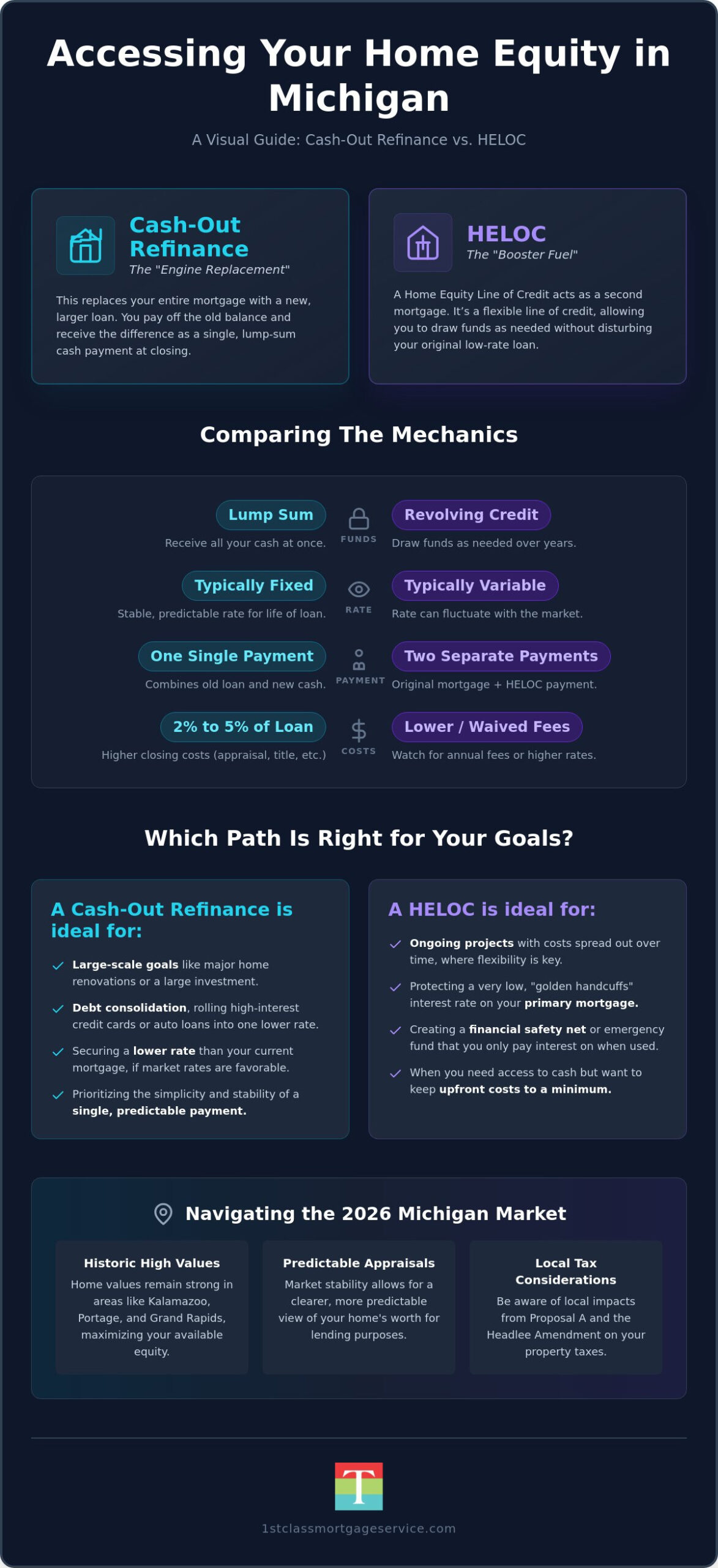
Think of your home equity as your financial altitude. In the 2026 West Michigan market, many homeowners in Kalamazoo and Portage have seen their altitude rise significantly due to steady property appreciation over the last several years. Tapping into that value requires choosing the right mechanical setup for your journey. A cash-out refinance Michigan involves replacing your current primary mortgage engine with a larger, more powerful one. You pay off the old balance and receive the difference in cash at closing. Conversely, a Home Equity Line of Credit (HELOC) acts like a secondary booster. It provides flexible access to fuel without disturbing your main engine’s settings or your original interest rate.
The year 2026 presents a unique window for West Michigan families. While the rapid price surges of the early 2020s have leveled off, home values remain at historic highs in areas like Battle Creek and Grand Rapids. This stability allows for more predictable appraisals, giving you a clear view of the equity available for your next big milestone. Whether you’re looking to consolidate debt or fund a major renovation, understanding these two distinct flight paths is the first step toward a successful landing.
How a Cash-Out Refinance Works in Practice
When you choose a cash-out refinance, you retire your existing debt entirely. You start a fresh amortization schedule with a new interest rate and a new term. This is an ideal move if your current mortgage rate is higher than today’s market offerings or if you want the simplicity of a single monthly payment. Your new loan amount is calculated based on current 2026 appraisals, which reflect the modern value of your neighborhood. Lenders typically maintain a safety ceiling of 80% loan-to-value for a cash-out refinance Michigan, ensuring you retain a 20% equity cushion in your property.
The Mechanics of a Home Equity Line of Credit (HELOC)
The mechanics of a HELOC are built around two distinct flight phases. During the initial draw period, which often lasts ten years, you can access funds as needed and often have the option for interest-only payments. This flexibility is perfect for ongoing projects where costs are spread out over time. Because the original mortgage stays in place, a HELOC is considered a second mortgage or a junior lien. It is a separate instrument from a traditional home equity loan, offering a revolving line rather than a single lump sum. Once the draw phase ends, you enter the repayment period, where you can no longer pull funds and must begin paying back the principal balance.
Comparing the Mechanics: Costs, Rates, and Monthly Stability
Choosing between these two equity tools requires looking at the “fuel consumption” of your loan over its entire lifespan. A cash-out refinance Michigan offers the steady altitude of a fixed-rate engine. You lock in a single interest rate and a predictable monthly payment for the next 15 or 30 years. In contrast, a HELOC typically operates on a variable-rate structure. While this might offer a smooth takeoff with a lower introductory rate, it exposes your budget to market turbulence. Comparing a HELOC and a home equity loan or line of credit reveals that while the latter offers flexibility, the lack of a fixed ceiling can lead to unexpected costs if national interest rates climb later in the decade.
Managing your monthly cash flow also looks different depending on your chosen path. The refinance approach provides one-payment simplicity by rolling your old debt and your new cash into a single monthly obligation. A HELOC creates a split-payment scenario, where you manage your original mortgage alongside a separate, fluctuating payment for the line of credit. Over a 10 to 20 year horizon, the total interest expense of a refinance might actually be lower if it allows you to consolidate higher-interest credit cards or auto loans into one lower, tax-efficient rate.
Upfront Costs vs. Long-Term Savings
Refinancing usually requires a higher upfront investment in “fuel.” In Michigan, closing costs typically range from 2% to 5% of the loan amount. You’ll need to account for specific title fees, recording taxes, and an appraisal fee that generally lands between $400 and $700. While these costs are higher than a HELOC’s setup fees, the long-term savings can be substantial if you’re securing a significantly lower rate than your current one. Don’t be swayed by the “zero-cost” HELOC myth; while some lenders waive initial fees, they often recoup those costs through annual maintenance charges or higher margins on the interest rate.
Payment Predictability in a 2026 Market
As we move through 2026, interest rate forecasts suggest a continued trend of modest decreases after the volatility of previous years. This makes fixed-rate stability particularly attractive for families in West Michigan who want to avoid the risk of “payment shock” when a HELOC draw period ends and principal repayment begins. Lenders in Kalamazoo and Grand Rapids will look closely at your total debt-to-income (DTI) ratio to ensure your new flight path is sustainable. If you’re ready to see how these numbers land for your specific property, reaching out to a local mortgage professional can help you calculate your exact break-even point.
Navigating the 2026 Michigan Real Estate Climate
The 2026 Michigan real estate market isn’t just a backdrop; it’s the weather system through which your financial flight must pass. In West Michigan hubs like Kalamazoo, Portage, and Battle Creek, home values have remained resilient. Data from 2025 indicates that about a third of Michigan homeowners are currently “equity rich,” meaning they own at least 50% of their homes. This significant cushion provides a sturdy safety margin for anyone considering a cash-out refinance Michigan. While the broader national market has seen fluctuations, our local geography benefits from consistent demand and a stable economic outlook that supports long-term property values.
Local appraisers in 2026 are looking for more than just square footage. They’re focusing on the stability of mechanical systems and the quality of recent functional upgrades. In West Michigan, where many homes have a storied history, showing meticulous care can significantly boost your appraised value. This is especially vital if you’re navigating the upcoming Fannie Mae condo guideline changes, which will increase reserve requirements from 10% to 15% starting in early 2027. Proper preparation ensures you maintain the lift needed to reach your financial destination without unexpected delays.
Kalamazoo and Portage Market Specifics
Equity growth in Portage has been particularly steady, often making a HELOC a savvy choice for smaller, targeted home improvements. If you’re planning a kitchen overhaul or a basement finish, these renovations can create “forced equity” that further increases your home’s value. Inventory levels in Kalamazoo remain lean, which keeps prices buoyant and protects your investment. To see how these local trends align with your borrowing power, check the current mortgage rates in Kalamazoo for real-time context on your flight plan.
Property Tax Implications of Tapping Equity
A common fear among Michigan homeowners is that a refinance might trigger a tax “uncapping.” Under Michigan’s Proposal A and the Headlee Amendment, your taxable value is capped and can only rise by the rate of inflation or 5%, whichever is less. It’s vital to understand that a cash-out refinance Michigan does not constitute a transfer of ownership. Therefore, it won’t uncap your taxes. Similarly, a second mortgage like a HELOC avoids these triggers entirely. The Consumer Financial Protection Bureau provides resources on how these different loan structures function, helping you avoid tax-related turbulence. Consulting with a local navigator ensures you stay within these protective regulations while maximizing your home’s potential.
Choosing Your Flight Path: When to Refinance vs. Open a HELOC
Selecting the right equity tool is like choosing the right aircraft for the distance of your trip. For a major overhaul, such as a full-scale addition or a complete modernizing of an older Kalamazoo home, a renovation mortgage or a full refinance often provides the most stable lift. These options allow you to lock in a fixed rate for the entire project cost, shielding you from future market shifts. If you’re looking to consolidate high-interest debt, a cash-out refinance Michigan acts as a clean slate approach. It lets you swap high-interest credit card balances for the lower, tax-efficient rate of a primary mortgage, simplifying your monthly logistics into a single, predictable payment.
Sometimes you don’t need a heavy-lift engine right away. A HELOC serves as the ultimate emergency parachute for West Michigan families. It provides a “just in case” fund that costs you nothing in interest until you actually pull the cord and draw the funds. This flexibility is also a powerful tool for portfolio expansion. Many local investors use their home’s equity to fuel the down payment for an investment property, often pairing it with a DSCR loan to grow their wealth without disturbing their primary residence’s stability.
The Golden Handcuffs Dilemma
Many homeowners in our community are currently wearing “golden handcuffs,” holding onto pandemic-era rates below 4%. If this is your situation, replacing that entire engine with a 2026-rate refinance might not make sense. In these cases, a HELOC is almost always the better choice. It leaves your low-rate primary mortgage untouched while giving you the cash you need. We can help you calculate a “blended rate” to see the true weighted cost of your combined debt, ensuring you don’t trade a great deal for a mediocre one.
Funding Life’s Major Milestones
Equity can also provide the momentum needed for life’s major milestones, like funding a child’s college tuition or launching a new business in Battle Creek. However, your timeline is a critical part of the flight plan. If you plan to move within 3 years, the high costs of a refinance rarely provide a positive ROI. For those staying long-term, tapping into your home’s value can be the most efficient way to reach your destination. If you’re ready to compare these paths for your specific home, speak with an expert navigator today to find your best route.
Charting Your Equity Flight Plan with a Local Michigan Expert
Choosing a path for your home’s value is more than a simple calculation; it’s a commitment to your family’s future security. Working with a local Kalamazoo navigator like Jeremy Drobeck ensures that your flight plan is built on local ground truth rather than distant algorithms. Big box lenders often view your home as a data point; we view it as the foundation of your life’s journey. The Treadstone difference is rooted in meticulous care, constant availability, and a deep understanding of the West Michigan landscape. We analyze your specific flight data, including your debt-to-income ratio and current equity position, to recommend the safest path for your unique situation.
A cash-out refinance Michigan provides a powerful engine for change, but it requires a precise hand on the controls to ensure the upfront costs don’t outpace the long-term benefits. By partnering with a local expert, you gain a steady, reliable ally who views the process as a significant life milestone. We stay present throughout the entire duration of the process, from the first conversation to the final signature at the closing table. This end-to-end support removes the high-stress barriers often associated with major financial commitments, replacing anxiety with a sense of calm, expert guidance.
The Personalized Navigational Review
Your journey begins with a personalized navigational review. To prepare for your first equity consultation, gather your recent pay stubs, tax returns, and your most recent mortgage statement. We’ll also look back at your purchase mortgage history to identify hidden opportunities for savings or more efficient loan structures. Our commitment to transparency means there are no hidden clouds or fine-print turbulence; you’ll receive a clear, honest breakdown of every fee and rate option available to you in the 2026 market.
Ready for Takeoff?
Initiating your equity review is a straightforward process that begins with a simple conversation. While a cash-out refinance Michigan typically follows a 30 to 45 day flight path to closing, a HELOC might offer a slightly faster approval timeline depending on the complexity of your appraisal. We’ll help you schedule your “altitude check” with a local appraiser who understands the specific value of your neighborhood. Treat your home equity as a strategic tool for growth rather than a gamble. With the right navigator by your side, you can tap into your home’s wealth with the confidence that you’ve chosen the most efficient route for your long-term financial success.
Securing Your Financial Altitude for the Journey Ahead
Choosing between the steady engine of a cash-out refinance Michigan and the flexible booster of a HELOC is a decision that shapes your entire financial horizon. You’ve seen how the 2026 market offers a unique landscape for homeowners in Kalamazoo and Portage. By matching your loan’s mechanics to your specific goals, you ensure your equity provides the necessary lift without creating unnecessary turbulence. Whether you are consolidating high-interest debt or funding a major home overhaul, the right flight plan makes all the difference in your long-term stability.
With over 20 years of West Michigan mortgage expertise, Jeremy Drobeck and the Treadstone Mortgage family, a division of Neighborhood Loans, Inc., are ready to guide you through every appraisal nuance and tax regulation. We provide the meticulous care and neighborly reassurance you deserve during this significant life milestone. We stay present throughout the entire duration of the process, ensuring you have a seasoned navigator at the controls.
Schedule Your Equity Flight Plan Consultation with Jeremy Drobeck today. It’s time to take command of your home’s wealth and enjoy a smooth landing at your next financial destination.
Frequently Asked Questions
Is a cash-out refinance better than a HELOC for home improvements in Michigan?
The best choice depends on the scale of your project. If you’re planning a major whole-home renovation in Kalamazoo, a refinance offers the stability of a fixed interest rate for the entire cost. For smaller, phased projects like a kitchen refresh, a HELOC provides flexible access to funds without disturbing your primary mortgage’s interest rate.
Can I get a HELOC if I already have a low-interest first mortgage?
Yes, this is a common strategy for homeowners who want to protect their “golden handcuffs” rate. A HELOC acts as a second mortgage, allowing you to access equity while keeping your low-interest primary engine untouched. It is an ideal way to gain liquidity without the need for a full replacement of your original loan.
How much equity do I need to qualify for a cash-out refinance in Kalamazoo?
Most lenders require you to maintain a 20% equity cushion in your property. This means your total loan amount for a cash-out refinance Michigan generally cannot exceed 80% of your home’s current appraised value. This safety margin protects your financial altitude if the local market experiences a shift.
What happens to my Michigan property taxes if I refinance my home?
Your property taxes will not “uncap” simply because you refinance. Since a cash-out refinance Michigan isn’t a transfer of ownership, your taxable value remains protected by Proposal A and the Headlee Amendment. Your taxes only rise by the rate of inflation or 5%, whichever is lower, regardless of your new loan amount.
Are the interest payments on a HELOC tax-deductible in 2026?
Interest is generally only deductible if the funds are used to buy, build, or substantially improve the home that secures the loan. If you use the equity for debt consolidation or tuition, the interest typically won’t be deductible under current 2026 guidelines. We always recommend consulting with a tax professional to review your specific flight plan.
How long does it take to close on a home equity loan in Portage or Battle Creek?
The timeline for a typical refinance is usually between 30 and 45 days. A HELOC can sometimes close slightly faster, depending on the speed of the local appraisal. We work closely with West Michigan appraisers to ensure your journey from application to funding is as efficient and smooth as possible.
Can I use a cash-out refinance to buy an investment property?
Yes, many Michigan homeowners use their primary equity to fund the down payment on a rental property. This strategy allows you to leverage your home’s value to build a larger portfolio. You can then pair that cash with a DSCR loan for the investment property to keep your personal and professional finances separate.
What are the typical closing costs for a Michigan refinance in 2026?
Closing costs in Michigan generally range from 2% to 5% of the loan amount. These costs cover the appraisal, title insurance, and state recording taxes. While these upfront fuel costs are higher than a HELOC, the long-term savings of a lower fixed rate can often justify the initial investment.



Latest Blog Post
S.O.S. SAVE OUR SALE
S.O.S. SAVE OUR SALE: WHAT TO DO WHEN YOUR LENDER STALLS WEEKS BEFORE CLOSING!
 Did your mortgage lender suddenly go radio silent, request the same bank statement for the fourth time, or drop a last-minute loan denial right before your scheduled closing date?
Yesterday, a panicked real estate agent called my office from Portage. Their buyer had been under contract for three weeks on a home near Milwood. The closing date sat just nine days away.
Out of nowhere, the buyer’s out-of-state call-center lender issued a denial letter. The call-center underwriter miscalculated self-employment write-offs, panicked over an unpermitted porch repair on the appraisal, and threw the entire transaction into the trash can.