Paying Cash vs. Financing a Home in Michigan 2026: A Strategic Guide
Writing a check for the full purchase price of a home feels like the ultimate power move to secure a smooth landing in today’s competitive market. However, the most direct route isn’t always the most efficient for your long-term wealth. While 26.2% of Michigan homes sold above list price recently, choosing between cash and strategic home financing options Michigan buyers use can be the difference between a grounded portfolio and one that truly takes flight.
It’s natural to feel anxious about 2026 interest rate volatility or the fear of being “house poor” despite owning the deed outright. You want the certainty of a closed deal without the heavy weight of unnecessary debt. We’ll help you analyze the financial mechanics behind cash offers and mortgage leverage to determine the most stable flight path for your purchase. This guide provides a clear framework for your decision by exploring tax implications, the hidden opportunity costs of cash, and how to maintain high-altitude liquidity while securing your home in the Great Lakes State.
Key Takeaways
- Understand how the 2026 Michigan market climate in Kalamazoo and Portage influences whether a cash offer or a mortgage provides the most stable landing gear for your purchase.
- Explore strategic home financing options Michigan buyers use to maintain liquidity and achieve greater long-term financial lift through the power of mortgage leverage.
- Compare the wealth-building trajectory of a total cash purchase against a diversified strategy that keeps your capital active in other high-growth investments.
- Learn about sophisticated maneuvers like delayed financing that allow you to win a competitive bid with cash while still enjoying the long-term benefits of a mortgage.
- Discover how a local navigator can help you engineer a personalized flight plan that balances immediate certainty with your future financial goals.
Navigating the 2026 Michigan Housing Market: Cash vs. Financing
Choosing how to pay for your home is like selecting the right fuel for a long-distance flight. Cash offers provide immediate landing gear, giving you the certainty of a closed deal without the technical hurdles of an appraisal. Financing, however, provides the lift necessary to keep your other financial goals airborne. In the high-velocity market of 2021, cash was often the only way to bypass a bidding war. The 2026 Michigan market requires more nuance. It’s a landscape showing signs of stabilization where strategic home financing options Michigan buyers choose are about long-term wealth management rather than just survival.
While cash is still a powerful tool, it’s no longer the only way to reach your destination. Inventory across the state is projected to grow by 5 to 10 percent in 2026. This shift gives buyers more breathing room to weigh the benefits of liquidity against the peace of mind that comes with a debt-free title. We view this decision as a navigation exercise. You aren’t just buying a house; you’re deciding where your capital will be most effective over the next decade.
The State of Michigan Real Estate in 2026
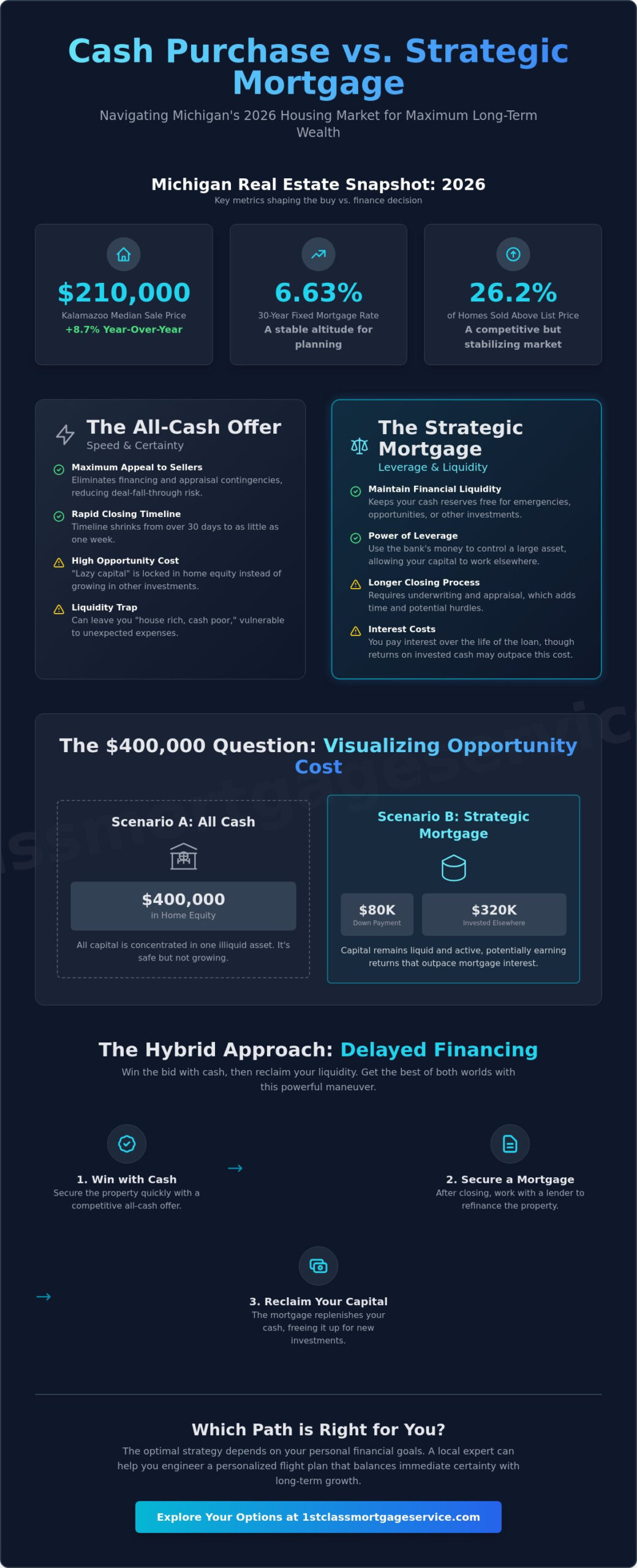
West Michigan continues to see steady appreciation that builds real equity for homeowners. In Kalamazoo, the median sale price reached $210,000 in May 2026, which is an 8.7 percent increase over the previous year. While prices are climbing, interest rates have found a steady altitude. As of June 2026, the 30-year fixed mortgage rate in Michigan sits at 6.63 percent. This stability allows for precise calculations that were impossible during the turbulence of the early 2020s. In local markets like Battle Creek or Portage, sellers are becoming more accustomed to balanced dynamics, meaning a well-structured mortgage can be just as attractive as a cash offer when presented by a reliable ally.
Defining Opportunity Cost for Homebuyers
Cash sitting in a home’s equity is often considered “lazy capital” because it’s difficult to access quickly. Once you lock $400,000 into a single asset, that money is no longer available for other maneuvers. A foundational step in this journey is understanding mortgage financing as a tool for leverage rather than just a burden. If you use a mortgage, you can keep your cash working in the stock market or a business venture where returns might outpace the cost of the loan.
For a $400,000 Michigan home purchase, the opportunity cost is the total potential profit you sacrifice by choosing the safety of home equity over the higher historical returns of a diversified investment portfolio.
The All-Cash Offer: Speed and Certainty in the Kalamazoo Market
An all-cash offer is the equivalent of a clear runway and perfect weather for a seller. It eliminates the financing contingency, which is often the primary source of turbulence during a real estate transaction. In competitive neighborhoods like Portage, where homes often move quickly, a cash offer can sometimes secure a discount because the seller values the guaranteed takeoff. Without the need for lender underwriting or a mandatory appraisal, the timeline from offer to keys can shrink from 30 days to just one week.
While this speed is intoxicating, it can lead to a liquidity trap. In the 2026 economy, having all your wealth grounded in a single asset can be risky. Even with the security of a paid-off home, you might find yourself cash-poor if an unexpected repair or life event occurs. This is why many savvy investors still evaluate strategic home financing options Michigan lenders provide to keep their capital mobile. While some buyers prefer the total independence of cash, others find that Michigan homeownership programs provide enough support to make financing a more attractive long-term play.
When Cash Makes the Most Sense
Cash acts as a heavy-duty tool for specific scenarios. If you’re eyeing a fixer-upper in Battle Creek that might not meet standard appraisal guidelines, cash allows you to bypass the inspection-based roadblocks that stop a traditional mortgage. Retirees often choose this path to eliminate monthly overhead, trading potential investment growth for the calm of a fixed housing cost. Some even use cash as a temporary bridge, securing the property first and then exploring a Purchase Mortgage later to reclaim their liquidity.
The Hidden Risks of Paying Cash
The most significant risk is often invisible: the loss of tax deductibility on mortgage interest. This is a missed opportunity for altitude gain that many high-income earners regret. Concentration risk is also a factor. If you tie your entire net worth to a single Michigan ZIP code, you’re vulnerable to local economic shifts. Un-sticking that cash later isn’t instant. Applying for a home equity line of credit involves fees and time, creating friction when you might need speed the most. Before you commit all your liquidity to a single deed, it’s worth seeing how a tailored mortgage might actually protect your future flexibility.
Why Financing a Home Often Provides Better Long-Term Financial Lift
While an all-cash offer provides a quick takeoff, financing is the engine that generates sustained lift for your overall net worth. Many buyers view a mortgage simply as a monthly obligation, but when used correctly, it’s a sophisticated tool for wealth accumulation. In the 2026 economy, strategic home financing options Michigan residents utilize focus on maintaining a high altitude for their total portfolio, not just their home equity. By utilizing a mortgage, you keep your liquid reserves intact, providing a safety net that cash-heavy buyers lack.
The decision to finance is often a question of where your “fuel” is most effective. Consider two different flight paths for $500,000 in capital. You could use it all to buy a single home in Portage, effectively grounding all that liquidity. Alternatively, you could put $100,000 down and invest the remaining $400,000 in a diversified portfolio. If your investments outpace the cost of debt, your total net worth reaches a much higher ceiling over time. This calculation depends heavily on staying informed about current mortgage rates, which currently sit at 6.63 percent for a 30-year fixed term in Michigan.
The Power of Mortgage Leverage
Leverage is the mechanical advantage that allows a small amount of effort to move a large object. In real estate, a 20 percent down payment allows you to capture 100 percent of the home’s appreciation. For example, if a $210,000 Kalamazoo home appreciates by 5 percent, you gain $10,500 in equity. If you paid cash, that’s a 5 percent return on your money. If you only put 20 percent down ($42,000), that same $10,500 gain represents a 25 percent return on your invested capital. A mortgage is considered good debt by wealth managers because it allows you to control a large, appreciating asset while keeping your primary capital available for higher-yield opportunities.
Tax Benefits and Deductions
Financing also offers structural advantages that cash cannot match, particularly through the Mortgage Interest Deduction. This allows you to deduct the interest paid on your loan from your taxable income, effectively lowering your real interest rate. These tax savings act as a recurring boost to your annual cash flow, which can then be reinvested to further increase your financial altitude. When navigating your purchase mortgage, it’s essential to look at the “after-tax” cost of the loan. Often, the net cost of borrowing is significantly lower than the headline rate, making strategic home financing options Michigan buyers choose a more efficient path than tying up every dollar in brick and mortar.
Strategic Hybrid Approaches: The Best of Both Worlds Solution
The choice between cash and debt doesn’t have to be a binary one. In fact, some of the most effective strategic home financing options Michigan buyers use involve hybrid maneuvers that combine the speed of cash with the long-term lift of a mortgage. These strategies allow you to secure a property with the certainty of a cash buyer while maintaining the liquidity required to keep your other financial goals at cruising altitude. By engineering your purchase this way, you avoid the risk of being grounded by a lack of liquid reserves.
One powerful tool in this category is the use of state-level support to preserve your capital. Even if you have a significant sum available, utilizing MSHDA Down Payment Assistance can help keep your cash in high-yield investments rather than sinking it into the foundation of your home. Additionally, strategies like recasting allow you to make a large principal reduction later and adjust your monthly payment without the cost of a full refinance. This flexibility ensures your flight path remains stable even if your financial circumstances change mid-journey.
Delayed Financing: The Competitive Edge
Delayed financing is a sophisticated maneuver that allows you to bypass the financing contingency to win a bid in a hot West Michigan market. You buy the home with cash to provide the seller with immediate certainty. Then, you immediately apply for a mortgage to pull your capital back out. Under 2026 guidelines, the “6-month rule” often applies to standard cash-out refinances, but delayed financing exceptions can allow you to reclaim your liquidity much sooner if the transaction is structured correctly from the start. This is a preferred strategy for high-net-worth buyers in Kalamazoo and Portage who want to win the house without permanently depleting their investment accounts.
Leveraging Specialized Loan Products
For those looking at properties as more than just a primary residence, specialized tools can offer a better ROI than an all-cash purchase. For instance, DSCR loans focus on the income potential of the property itself, allowing investors to scale their portfolios without tying up personal cash flow. If you find a property that needs a bit of mechanical work to reach its full potential, our renovation mortgage guide explains how to fund improvements that jump-start your home’s value from day one. These hybrid paths ensure your capital remains mobile while your equity continues to climb. If you’re ready to engineer a custom solution for your next move, contact our team to discuss your 2026 flight plan.
Charting Your Course: How Jeremy Drobeck Helps You Decide
Deciding between an all-cash purchase and a leveraged mortgage isn’t just a math problem; it’s a navigation challenge that requires a clear view of the entire horizon. While the data points we’ve discussed provide the technical foundation, every homebuyer’s financial cockpit looks different. Jeremy Drobeck moves beyond transactional lending to act as your strategic partner, ensuring that the strategic home financing options Michigan families select actually align with their 2026 wealth goals. His service doesn’t just process applications; it engineers outcomes that protect your liquidity while securing your place in the West Michigan community.
Local expertise is the secret to a smooth landing in markets like Kalamazoo, Portage, and Battle Creek. A national lender might see a zip code, but a local navigator understands the specific nuances of neighborhood appraisal trends and seller expectations in our region. Jeremy Drobeck provides more than just a loan; he offers the Flight Plan necessary to ensure your home purchase doesn’t stall your other investments. He’s present throughout the entire duration of the process, providing a steady hand from the initial pre-approval to the final signature at the closing table.
Customized Financial Flight Plans
Jeremy Drobeck’s consultation process follows a deliberate “Problem-Analogy-Solution” framework to demystify complex lending mechanics. If the problem is a fear of tying up too much cash in a single asset, he might compare your home equity to a reserve fuel tank: it’s essential to have, but you don’t want your entire payload dedicated to it. He analyzes your liquid assets against your long-term wealth projections to find the “sweet spot” of leverage. This personalized approach ensures you aren’t just following a generic trend but are instead executing a plan built for your specific financial altitude.
Ready for Takeoff in West Michigan?
The 2026 market offers unique opportunities for those who know how to read the instruments. Whether you’re considering an all-cash bid to win a competitive Portage listing or looking to utilize a strategic home financing options Michigan strategy to keep your capital working elsewhere, Jeremy Drobeck is here to run the numbers with you. He prides himself on premium-tier service and meticulous care, treating your milestone with the respect it deserves. Don’t leave your financial future to chance when you can have a seasoned navigator by your side. Chart your course with a personalized consultation today and let’s prepare for a successful takeoff.
Engineer Your Successful Landing in West Michigan
Choosing between the immediate certainty of cash and the long-term lift of a mortgage is a pivotal decision for your 2026 home purchase. While an all-cash offer can secure a quick takeoff in competitive markets like Portage, it shouldn’t come at the cost of grounding your entire liquid reserve. By exploring strategic home financing options Michigan residents use, you can maintain the flexibility to reinvest capital while still capturing 100 percent of your property’s appreciation. Whether you’re interested in hybrid strategies like delayed financing or specialized tools like DSCR loans, the right flight plan ensures your wealth stays airborne.
With over 20 years of West Michigan expertise and specialized knowledge in MSHDA and investment programs, our team is ready to act as your seasoned navigator. We view every transaction as a significant life milestone that requires precision and personalized care. As a division of Neighborhood Loans, Inc. (NMLS #222982), we’re committed to your safety and success throughout the entire journey. Schedule your 2026 Financial Flight Plan with Jeremy Drobeck to run the numbers for your specific goals. Let’s work together to find the most stable path for your next move.
Frequently Asked Questions
Is it better to pay cash for a house if I can afford it in 2026?
The decision depends on your personal wealth altitude and your need for liquid capital. While paying cash eliminates monthly debt, it grounds a significant amount of money in a single, illiquid asset. In the 2026 economy, many buyers find that financing actually provides better lift for their total portfolio by allowing them to invest their cash in higher-yielding opportunities.
Does a cash offer really help me win a bidding war in Michigan?
Yes, cash offers provide sellers with a high-confidence landing gear because they bypass financing contingencies and appraisals. In 2025, about 26.2 percent of Michigan homes sold for more than the asking price. Cash can be a deciding factor in competitive Portage or Kalamazoo neighborhoods, though it isn’t the only way to secure a successful deal.
Can I get a mortgage after I buy a house with cash?
You can utilize a maneuver called delayed financing to reclaim your capital shortly after closing. This strategy allows you to win a bid with the certainty of a cash offer and then transition to a mortgage to restore your liquidity. It’s one of the most effective strategic home financing options Michigan buyers use to keep their investment portfolio mobile and active.
What are the tax disadvantages of paying cash for a home?
The primary disadvantage is the loss of the Mortgage Interest Deduction, which can lower the real cost of your loan. By paying all cash, you miss out on a structural tax benefit that reduces your annual taxable income. For many high-altitude earners, this deduction makes financing a more efficient path than owning a home outright without any leverage.
How do 2026 interest rates impact the decision to finance vs. pay cash?
Stabilizing rates in 2026, currently around 6.63 percent for a 30-year fixed mortgage, make the cost of debt predictable. When rates are steady, the math becomes much clearer for comparing mortgage costs against potential investment returns. If your diversified investments can earn more than the after-tax cost of your loan, financing remains the smarter navigation choice for long-term growth.
What happens if the Michigan real estate market declines and I paid all cash?
If the market declines, an all-cash buyer sees a direct reduction in their net worth because their capital is locked in the devaluing asset. While you won’t have a monthly payment, you also don’t have the hedge of using a lender’s money. Financing allows you to keep your primary cash in diversified reserves that aren’t tied to the performance of a single Michigan zip code.
Is there a middle ground between a 20% down payment and an all-cash offer?
A larger down payment, such as 30 to 50 percent, serves as a stabilizer between full debt and full cash. This strategy reduces your monthly overhead and interest costs while keeping a significant portion of your capital available for other maneuvers. It allows for a controlled descent into homeownership without completely depleting your liquid fuel reserves.
How much cash should I keep in reserve after buying a Michigan home?
Most financial navigators recommend keeping at least six to twelve months of living expenses in liquid reserves after your purchase. Owning a home in Michigan involves maintenance and property taxes, which have an effective rate of 1.19 percent in 2026. Maintaining this safety net ensures you have the lift needed to handle unexpected repairs without experiencing financial turbulence.



Latest Blog Post
S.O.S. SAVE OUR SALE
S.O.S. SAVE OUR SALE: WHAT TO DO WHEN YOUR LENDER STALLS WEEKS BEFORE CLOSING!
 Did your mortgage lender suddenly go radio silent, request the same bank statement for the fourth time, or drop a last-minute loan denial right before your scheduled closing date?
Yesterday, a panicked real estate agent called my office from Portage. Their buyer had been under contract for three weeks on a home near Milwood. The closing date sat just nine days away.
Out of nowhere, the buyer’s out-of-state call-center lender issued a denial letter. The call-center underwriter miscalculated self-employment write-offs, panicked over an unpermitted porch repair on the appraisal, and threw the entire transaction into the trash can.