
How to Protect Yourself During Mortgage Closing: Your 2026 West Michigan Safety Plan
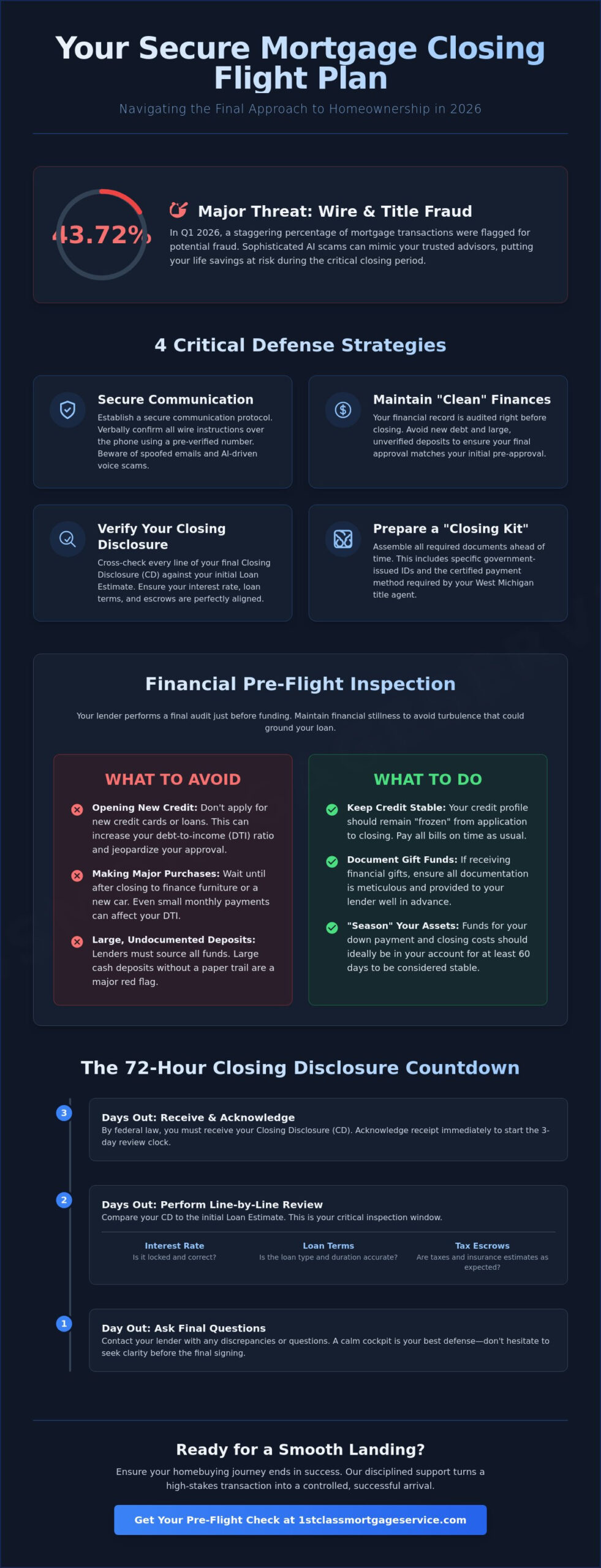
Did you know that in the first quarter of 2026, a staggering 43.72% of mortgage transactions were flagged for wire and title fraud risks? Learning how to protect yourself during mortgage closing is no longer just a recommendation; it’s a critical pre-flight safety check for your life savings. You’ve worked incredibly hard to reach this milestone, and it’s natural to feel a bit of turbulence as you approach the final landing. The West Michigan housing market moves fast, and the pressure to sign stack after stack of complex documents can feel overwhelming when your future home is on the line.
We’re here to help you master this final approach with expert strategies to secure your funds, verify every line of your Closing Disclosure, and keep your credit stable until the keys are in your hand. You deserve total confidence that your money is reaching the right destination and that every detail of your loan is accurate. This guide provides a clear flight path through the 2026 regulatory landscape, from spotting sophisticated phishing schemes to understanding how the latest executive orders on mortgage credit might affect your final paperwork.
Key Takeaways
- Establish a secure communication protocol to defend against AI-driven wire fraud and spoofed emails targeting your closing funds.
- Understand why a “clean” financial record is essential for your final audit and how to protect yourself during mortgage closing by avoiding new debt or large, unverified deposits.
- Learn to cross-check your final Closing Disclosure against your initial loan estimate to ensure your locked interest rate and tax escrows are perfectly aligned.
- Prepare for your final descent by assembling a “closing kit” that includes the specific IDs and certified payment methods required by West Michigan title agents.
Understanding the Mortgage Closing Landscape in 2026
The real estate closing process is the final descent of your homebuying journey. It is the technical moment when the legal title officially shifts from the seller to you and the mortgage funds are released to the appropriate parties. In West Michigan, this is often seen as a celebratory milestone; however, in 2026, it requires the precision of a master navigator. With 43.72% of mortgage transactions being flagged for wire and title fraud risks in the first quarter of this year, the margin for error has narrowed. Sophisticated AI tools now allow scammers to mimic the voices and writing styles of your trusted advisors with frightening accuracy. Understanding how to protect yourself during mortgage closing means recognizing that the final few miles of the process are often the most technical. You aren’t flying solo. Your lender, the title agent, and your real estate guide act as your ground crew to ensure a safe, engineered arrival.
Why the Final 72 Hours Are Critical
The countdown begins with the Closing Disclosure (CD). Federal law requires you to receive this document at least three business days before you sign the final papers. This window is your chance to perform a rigorous pre-flight inspection. You must compare every line item on the CD to your initial Loan Estimate. Look for changes in the interest rate, loan terms, or estimated taxes. While a March 2026 executive order has prompted agencies to consider more flexible, materiality-based standards for these timelines, the core protection remains the same. Local experts in the Kalamazoo market are particularly diligent about these windows. They ensure you have the time to ask questions before the clock runs out.
The Emotional High Stakes of the Finish Line
Buying a home is likely the largest financial commitment you will ever make. It is perfectly normal to feel a surge of adrenaline or anxiety as the date approaches. However, a calm cockpit is your best defense against oversight. When stress levels spike, it is easy to gloss over a decimal point or ignore a suspicious email. Neighborly reassurance from a steady ally can lower these barriers. By replacing panic with expert guidance, you can maintain the focus needed to spot discrepancies and truly master how to protect yourself during mortgage closing. We view this process as a significant life milestone. Our goal is to provide the disciplined support necessary to turn a high-stakes transaction into a controlled, successful arrival.
Your Financial Pre-Flight Inspection: Protecting Your Approval
Securing your initial approval is like reaching cruising altitude, but the most critical phase of your journey is the final approach to the runway. Many homebuyers mistakenly believe that once they have a pre-approval letter, their financial behavior no longer impacts the deal. In reality, the final audit happens just days before funding. Learning how to protect yourself during mortgage closing requires a commitment to financial stillness. Any sudden movement in your debt levels or bank balances can ground your flight before you ever reach the closing table. Your credit and assets must remain consistent to ensure the lender’s final risk assessment matches the original flight plan.
Avoiding Last-Minute Credit Turbulence
Lenders perform a “soft pull” or a final check through a Loan Delivery Program (LDP) right before the funds are released. This is a standard safety measure to verify that no new liabilities have been added to your profile. Opening a new credit card to buy furniture or financing a new vehicle for your new garage can spike your debt-to-income (DTI) ratio. Even a small monthly payment can push you past the qualifying limit. In the 2026 mortgage landscape, your credit profile must remain frozen in time from application to the final signature. If you feel the urge to make a major purchase, wait until the keys are in your hand and the deed is recorded.
Documenting the Source of Funds
Your bank statements must remain “clean” for the final audit. Lenders are required to source and document every dollar used for your down payment and closing costs. Large, unexplained deposits often trigger red flags because they could represent undisclosed loans. If you are receiving gift funds or utilizing Michigan First Time Home Buyer Programs like MSHDA, the documentation must be meticulous. Seasoning is also vital; funds typically need to be in your account for at least sixty days to be considered stable assets. For a precise look at how these numbers should appear on your final paperwork, you can use this Closing Disclosure explainer tool to verify your totals.
Employment stability is the final engine of your approval. While a better job offer might seem like a win, switching employers in the final week can cause significant delays. Lenders perform a verbal verification of employment within ten days of closing to ensure your income stream is secure. If you anticipate any changes to your job status or salary, you must disclose them to your mortgage navigator immediately. We are here to help you navigate these shifts so that your purchase mortgage stays on track for a successful landing.
Defending Your Wealth: Preventing Wire Fraud and Scams
In 2026, the digital perimeter of your real estate transaction faces constant pressure from sophisticated cyber threats. Scammers no longer rely on clumsy, poorly written emails; instead, they use generative AI to clone the specific tone and vocabulary of your real estate agent or lender. This makes it incredibly difficult to distinguish a legitimate update from a malicious spoofing attempt. Learning how to protect yourself during mortgage closing requires you to adopt a “zero-trust” policy regarding your funds. Your life savings represent years of hard work, and protecting that capital is just as important as securing the loan itself. We view ourselves as your digital ground crew, helping you navigate these hazards with a disciplined safety protocol.
The “Golden Rule” of mortgage safety is simple: never trust an emailed change in wire instructions. Title companies and lenders almost never change their banking details mid-process. If you receive an “urgent” or “last-minute” email claiming that the wiring destination has changed due to an internal audit or technical glitch, it is a massive red flag. These spoofed emails often look identical to previous communications from Jeremy Drobeck – Treadstone Mortgage or your title agent. They use the same logos, signatures, and even the same conversational style. Always assume that any emailed instruction regarding money is a potential threat until you verify it through a secondary, offline channel.
The 4-Step Wire Safety Protocol
To ensure your funds reach the correct destination, follow this engineered checklist every time you move money:
- Step 1: Obtain your initial wire instructions early in the process through a secure, encrypted portal or in person at the title office.
- Step 2: Implement “Voice Verification.” Before sending any funds, call your title agent using a known, verified phone number from their official website. Do not use the number provided in a recent email.
- Step 3: If your bank and title company allow it, send a small “test” wire of a few hundred dollars to confirm the path is clear.
- Step 4: Call the title company within 30 minutes of the full transfer to confirm they have received the funds in their account.
What to Do if You Suspect a Security Breach
If you realize you have sent money to a fraudulent account, you must act with extreme speed. The first 24 hours are the “golden window” where banks may still be able to freeze the transfer before the hackers move it offshore. Immediately contact your bank’s fraud department and file a report with the FBI Internet Crime Complaint Center (IC3). Having a local Kalamazoo lender who is accessible and answers the phone in a crisis is a vital layer of protection. This neighborly support ensures you aren’t stuck in an automated phone tree while your savings are at risk. Understanding how to protect yourself during mortgage closing means knowing exactly who to call when the flight path gets bumpy.
Reviewing the Closing Disclosure: A Line-by-Line Defense
The Closing Disclosure (CD) is the final flight manifest of your home purchase. It serves as the definitive record of your loan terms, closing costs, and the exact amount of cash you need to bring to the table. Learning how to protect yourself during mortgage closing involves a meticulous, line-by-line comparison of this document against your initial Loan Estimate. Any discrepancy, no matter how small, requires immediate attention before you sign. This document is your final chance to ensure the financial mechanics of your deal are exactly what you agreed to during the application phase.
Start with the “Loan Terms” section on page one. If you locked your interest rate in early June 2026, it should reflect the current market averages of approximately 6.28% to 6.54% for a 30-year fixed mortgage. Next, examine the “Projected Payments.” This area outlines your monthly principal and interest, but it also includes your escrow requirements. Understanding what escrow means for Kalamazoo homebuyers is vital here, as it covers your property taxes and homeowners insurance. You will also see “Prepaid” items, such as the first year of insurance and daily interest charges that accrue from the day of closing until the end of the month. These are standard costs, but the numbers should be consistent with your earlier estimates.
Spotting Clerical Errors and “Junk Fees”
A simple typo can ground your closing. Check that your name is spelled exactly as it appears on your government ID and verify the property address for accuracy. If these details are wrong, it can delay the recording of your deed at the county office. You must also ensure that every credit you earned during the journey is present. This includes seller concessions for repairs or any MSHDA down payment assistance if you are using a state-backed program. The “Total Cash to Close” at the bottom of page three should align perfectly with the figures provided by your mortgage navigator earlier in the week.
Understanding Title Insurance and Search
Before the title agent clears you for departure, they perform a title search to ensure the property is free of historical “turbulence.” In local markets like Kalamazoo or Portage, this search is your shield against old mechanics’ liens, unpaid property taxes, or undisclosed heirs from decades ago. Title insurance is a one-time premium that protects your ownership rights against historical claims, such as unpaid property taxes or undisclosed heirs. While the Lender’s Title Insurance protects the bank’s investment, the Owner’s Title Insurance is what secures your personal equity. Reviewing these line items is a final, vital step in how to protect yourself during mortgage closing. If you are ready to secure a purchase mortgage with a team that watches every detail, reach out to us today.
The Final Descent: Closing Day Logistics and Post-Closing Safety
Closing day is the moment your wheels finally touch the tarmac. After weeks of preparation and the rigorous review of your final disclosures mentioned previously, you’re ready to finalize the transfer of ownership. To ensure a smooth arrival, arrive at the title office with your “closing kit” fully prepared. This kit should include two forms of valid government identification and a certified check if you haven’t already completed a secure wire transfer. In the Kalamazoo market, the title agent and notary act as your flight controllers. They facilitate the signing of the mortgage note and deed of trust. Learning how to protect yourself during mortgage closing means recognizing that your signature is your legal bond. You shouldn’t feel pressured to sign a document you don’t fully understand. If a specific clause feels confusing, ask for a clear explanation before the ink dries.
The Closing Day Checklist
Your final descent involves more than just a stack of paperwork. It’s your last opportunity to verify the property’s condition and ensure all terms of the sale have been met. A successful landing requires a final walkthrough of the home just hours before your appointment. Check that the seller has completed all agreed-upon repairs and that the property is in the condition promised in your contract. Once you’re at the closing table, ensure the following logistics are handled:
- Confirm that all keys, garage door openers, and smart home security codes are handed over immediately.
- Verify the exact mailing address and digital payment instructions for your first mortgage payment.
- Check that your name and the property address are spelled correctly on every single page to avoid future title turbulence.
Protecting Your Home After the Landing
The need to know how to protect yourself during mortgage closing doesn’t end when you leave the title office. In the weeks following your purchase, your mailbox will likely be flooded with “junk mail” that mimics official government notices. Scammers often send letters offering a “certified copy of your deed” for a high fee or “mortgage protection insurance” that looks like a mandatory bill from your lender. These are almost always predatory solicitations. Your original deed will be mailed to you directly by the county register of deeds after it’s recorded; there’s no need to pay a third party for a copy. Store your original documents in a fireproof safe or a secure deposit box. Even after the keys are in your hand, Jeremy Drobeck – Treadstone Mortgage remains your navigator, ready to assist with any questions as you settle into your new West Michigan home.
Secure Your Final Approach to Homeownership
Transitioning from a pre-flight financial inspection to the tactical defense of your wire transfers is the final stage of your homeownership journey. By verifying every instruction through voice confirmation and auditing your Closing Disclosure line-by-line, you’ve built a powerful shield against the turbulence of 2026. Mastering how to protect yourself during mortgage closing ensures that your life savings remain secure as you move from the closing table to your new front door. You don’t have to navigate these high-stakes final miles without a seasoned ally by your side.
With over 20 years of West Michigan lending expertise, Jeremy Drobeck – Treadstone Mortgage provides the steady hand and direct accessibility you need for a stress-free keys-in-hand moment. Whether you’re utilizing MSHDA down payment assistance or a specialized renovation mortgage, our team is present throughout the entire process to ensure every detail is engineered for your success. Don’t leave your final signature to chance. Schedule your pre-closing flight check with Jeremy Drobeck – Treadstone Mortgage today and move forward with total confidence. Your new beginning in Kalamazoo or the surrounding community is just a few safe steps away.
Frequently Asked Questions
How far in advance should I receive my closing disclosure?
You must receive your Closing Disclosure at least three business days before you sign your final paperwork. This federal safety buffer is designed to give you ample time to perform a final inspection of your loan terms and closing costs. If your lender makes significant changes to the loan product or your interest rate during this window, the clock typically resets. This ensures you aren’t forced into a last-minute decision under pressure as you approach your final landing.
Can I use a personal check for my closing costs in Michigan?
Personal checks are typically not accepted for closing costs in Michigan because the funds aren’t immediately verified. Most title companies require a wire transfer or a certified cashier’s check from your bank to ensure the money is available for disbursement. You should verify the specific payment requirements with your title agent at least 48 hours before your appointment. This preparation prevents technical friction that could delay your keys-in-hand moment.
What happens if I find an error on my closing documents at the table?
If you spot an error at the closing table, you should point it out immediately before signing any pages. Minor clerical typos, such as a misspelled middle name, can often be corrected on the spot by the title agent. However, if the discrepancy involves your loan terms or interest rate, the process may need to be paused to generate new documents. Knowing how to protect yourself during mortgage closing means being willing to wait for precision rather than signing incorrect legal paperwork.
Is wire fraud really that common in the mortgage industry?
Fraud is a persistent threat in the current market, with 22% of homebuyers reporting that they have received fraudulent communications during their transaction. Scammers often target the final 72 hours of a deal when stress levels are high and details are moving quickly. This is why we emphasize the “Voice Verification” protocol. Taking five minutes to call a known number to verify instructions can save your entire life savings from a sophisticated phishing attempt.
Who actually attends the closing meeting in West Michigan?
In a typical West Michigan closing, the primary attendees are you, the title company representative, and often your real estate agent. While many lenders are not physically present at the table, your mortgage navigator should be available by phone throughout the duration of the meeting. The title agent acts as a neutral third party, managing the legal paperwork and ensuring your deed is recorded correctly with the county office after the signing is complete.
What should I do if my wire transfer is delayed on closing day?
If your wire transfer is delayed, you should immediately contact your bank’s wire department to obtain the “Federal Reference Number.” Share this number with your title agent so they can track the incoming funds through the Federal Reserve system. Delays often happen due to internal bank security reviews or specific cut-off times. Staying in constant communication with your ground crew helps manage these hurdles and ensures your purchase mortgage stays on the flight path toward funding.
Why did I receive a bill for a “copy of my deed” in the mail?
These mailers are predatory solicitations that target new homeowners by mimicking official government correspondence. You don’t need to pay a private company for a copy of your deed. After your closing, the local County Register of Deeds records the document and mails the original directly to you at no additional cost. If you receive a bill for this service in the mail, it’s a scam; you should shred it or report it to your mortgage advisor for verification.
Can my mortgage rate change between the disclosure and the closing?
Your interest rate should remain stable if you have a valid rate lock in place. However, if your lock expires or if there are material changes to your credit profile, the rate could fluctuate. Reviewing your final paperwork is a critical part of how to protect yourself during mortgage closing. If the rate on your final disclosure doesn’t match your original lock agreement, you should stop the process and ask for a detailed explanation before signing.



Latest Blog Post
S.O.S. SAVE OUR SALE
S.O.S. SAVE OUR SALE: WHAT TO DO WHEN YOUR LENDER STALLS WEEKS BEFORE CLOSING!
 Did your mortgage lender suddenly go radio silent, request the same bank statement for the fourth time, or drop a last-minute loan denial right before your scheduled closing date?
Yesterday, a panicked real estate agent called my office from Portage. Their buyer had been under contract for three weeks on a home near Milwood. The closing date sat just nine days away.
Out of nowhere, the buyer’s out-of-state call-center lender issued a denial letter. The call-center underwriter miscalculated self-employment write-offs, panicked over an unpermitted porch repair on the appraisal, and threw the entire transaction into the trash can.