MSHDA Loan Requirements in Michigan: Your 2026 Homeownership Flight Plan
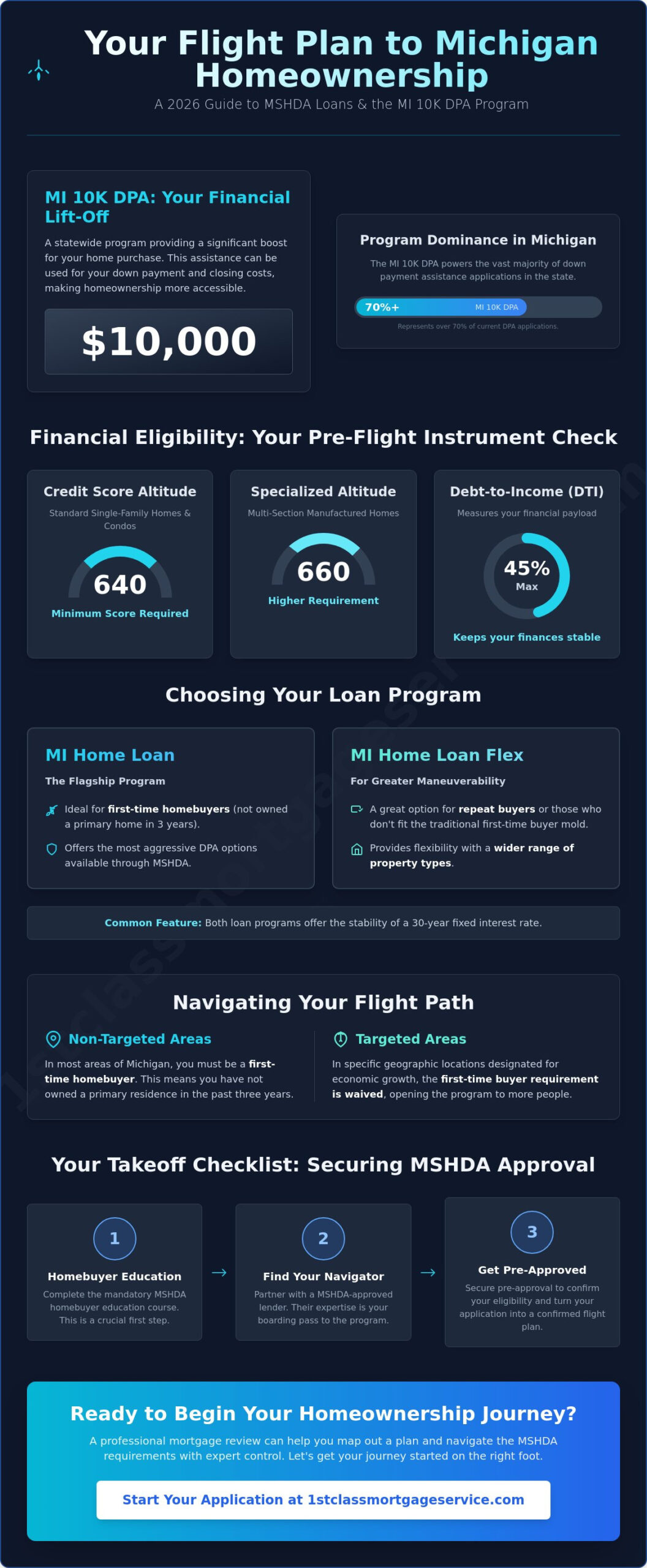
Over 70% of current down payment assistance applications in Michigan are now powered by a single program: the MI 10K DPA. It’s natural to feel a bit of turbulence when you’re looking at your bank account and wondering if you have enough for a down payment or if your credit score will ground your dreams before they even take off. You aren’t alone in feeling overwhelmed by the shifting landscape of income limits and property rules. We believe that every Michigander deserves a clear path to the front door of their own home. That’s why we’ve engineered this guide to help you master the MSHDA loan requirements Michigan home buyers must navigate in 2026.
By understanding these specific financial mechanics, you can replace anxiety with a sense of calm, expert control. This flight plan provides a transparent breakdown of the mandatory homebuyer education, the minimum 640 credit score threshold, and the updated income limits for counties from Kalamazoo to Kent. We’ll also explore how the statewide expansion of the $10,000 assistance program can provide the necessary lift for your purchase mortgage. Whether you’re a first-time buyer or looking at a targeted area, we’re here to ensure your paperwork is flight-ready and your journey is successful.
Key Takeaways
- Learn how the 2026 MSHDA loan requirements Michigan home buyers must meet can act as your personal flight plan, clearing the path to homeownership with lower interest rates.
- Discover the specific credit score altitudes you need to reach, including the standard 640 minimum and the specialized 660 requirement for manufactured housing.
- Understand how to harness the MI 10K DPA program to provide $10,000 in immediate lift for your down payment and closing costs.
- Navigate the updated income caps and sales price limits for West Michigan counties to ensure your household eligibility remains within the program’s ceiling.
- Prepare for takeoff by mastering the mandatory homebuyer education and pre-approval steps that turn your application into a confirmed boarding pass.
Decoding MSHDA Loan Requirements: The Mechanics of Your Flight Plan
Think of MSHDA as the state-backed engine providing the necessary lift for your homeownership journey. Established in 1966, the Michigan State Housing Development Authority (MSHDA) serves as a stabilizing force in the local market by offering specialized financial tools. It doesn’t just offer loans; it creates a structured environment where competitive interest rates and robust down payment assistance (DPA) work together. For many, these programs represent the difference between staying grounded in a rental and finally achieving takeoff in a home of their own. It is a partnership designed to make the dream of owning a piece of Michigan achievable for those who might feel sidelined by traditional lending rules.
2026 marks a significant era for Michigan buyers because the popular MI 10K DPA program has now fully expanded statewide. This expansion means the specific MSHDA loan requirements Michigan residents must meet are more accessible to a wider range of families than in previous years. Whether you are a first-time pilot or a seasoned homeowner, your eligibility often depends on your specific flight path within the state. In “Targeted” areas, which are specific geographic locations designated for economic growth, the requirement to be a first-time buyer is waived. In “Non-Targeted” areas, you generally need to be a first-time buyer, which means you haven’t owned a primary residence in the last three years. This distinction is a vital part of your initial preparation.
The MI Home Loan vs. MI Home Loan Flex
Choosing the right equipment is vital for a smooth journey. The standard MI Home Loan is the flagship program, offering a steady trajectory for first-time buyers who meet the basic 640 credit score threshold. If you’ve owned a home before or have a slightly different financial profile, the MI Home Loan Flex offers more maneuverability. While the standard program is often paired with the most aggressive DPA options, the Flex program allows for more varied property types and can be a better fit for those who don’t fit the traditional first-time buyer mold. Both options provide the stability of a 30-year fixed rate, ensuring your monthly costs don’t experience unexpected turbulence.
Why Your Choice of Navigator Matters
A flight plan is only as good as the person executing it. Working with a MSHDA-approved lender is your boarding pass to these specialized programs. In communities like Kalamazoo and Portage, local expertise ensures that your application doesn’t get stuck in a holding pattern while you wait for approvals. You need a navigator who views your mortgage as a life milestone rather than a cold transaction. This personalized care ensures that every requirement, from income caps to property inspections, is handled with precision before you reach the runway. A seasoned expert will help you select the specific loan type, like an FHA or Conventional mortgage, that best complements the MSHDA assistance.
Financial Eligibility: Credit Scores and Debt-to-Income Ratios
Before you can clear the runway for takeoff, your financial instrument panel needs to show specific, steady readings. The MSHDA loan requirements Michigan buyers face in 2026 prioritize long-term stability over sheer speed. Your credit score acts as your minimum altitude. For most standard single-family homes or approved condominiums, a 640 score is the baseline required to move forward. However, if your heart is set on a multi-section manufactured home, you’ll need to reach a slightly higher altitude of 660. This specific distinction is vital. Many generic guides overlook the higher requirement for manufactured housing, which can lead to frustrating mid-flight delays if you aren’t prepared from the start.
Your Debt-to-Income (DTI) ratio measures the weight your financial engine carries relative to its total power. MSHDA typically enforces a ceiling of 45% for this ratio. This calculation ensures that your total monthly obligations, including your future mortgage payment, don’t exceed 45% of your gross monthly income. It’s a safety protocol designed to prevent an “engine stall” once you’ve moved into your new home. If you’re worried your current debts are too heavy, a professional mortgage review can help you map out a plan to lighten the load before you officially file your application and begin your journey.
Credit Challenges and Course Correction
Sometimes, your score might be stuck in a low-pressure system. If you’re currently below the 640 mark, don’t abandon the mission. Course correction is often possible through strategic debt repayment or resolving inaccuracies on your credit report. Collections or past credit events don’t always ground your application indefinitely, but they do require a seasoned navigator to explain the context to underwriters. We recommend a full pre-flight credit audit at least three to six months before you plan to buy. This gives you the runway needed to boost your score and secure the best possible interest rates.
Assets and Reserves: Your Emergency Fuel Tank
Even with the MI 10K DPA Loan providing significant lift for your down payment, you’ll still need an emergency fuel tank of your own. MSHDA generally requires borrowers to contribute at least 1% of the loan amount from their own personal funds. This demonstrates your commitment to the journey and ensures you have some “skin in the game.” While you can use gift funds from family members to help cover additional costs, that initial 1% must be documented carefully. We’ll help you organize your bank statements and asset records so your underwriting process remains smooth and free of unexpected turbulence.
Income Limits and Household Eligibility in West Michigan
Every flight plan has a ceiling, and for this program, that ceiling is defined by your income. The MSHDA loan requirements Michigan buyers must follow are designed to provide the most lift to those within specific financial brackets. These limits aren’t a one-size-fits-all rule; they fluctuate based on your county and the number of people in your household. In West Michigan, these thresholds are actually quite accommodating. For example, in Kalamazoo County, the 2026 income limit for a household of one or two people is $129,720. If your family size is three or more, that limit increases to $151,340. These figures, sourced directly from the Michigan State Housing Development Authority (MSHDA), ensure the program supports a broad range of local professionals and families.
A common point of confusion for many pilots is the difference between qualifying income and household income. Your lender uses qualifying income to determine the size of the mortgage you can safely pilot. However, MSHDA evaluates eligibility based on the total household income. This includes the gross earnings of every person aged 18 or older who will reside in the property, even if they aren’t signed onto the mortgage. For MSHDA purposes, household income is defined as the total projected gross income of all occupants aged 18 and older who will live in the home, regardless of whether they are on the mortgage loan. When we calculate this, we must include overtime, bonuses, and part-time earnings to ensure your flight path stays within the legal limits.
Navigating Targeted vs. Non-Targeted Areas
Your destination within Michigan can change the rules of your journey. MSHDA classifies certain areas as “Targeted,” which are geographic zones prioritized for community investment. If you choose a home in a targeted census tract in Battle Creek or Kalamazoo, the standard requirement to be a first-time homebuyer is completely waived. This means you can secure a MSHDA loan even if you’ve owned a home recently. Additionally, these targeted zones often feature higher income and purchase price ceilings, giving you more maneuverability in your home search. We use the latest MSHDA mapping tools to help you identify these zones so you can maximize your program benefits.
Calculating Your Total Household Income
Precision is key when documenting your financial status. Because MSHDA looks at the “projected” income for the next 12 months, we don’t just look at last year’s tax returns. We analyze your current pay stubs and employment history to account for any upward trends in your earnings. This thorough approach prevents mid-flight turbulence during the final underwriting stages. By identifying every source of income early, we ensure your boarding pass is valid and your eligibility is secure before you ever make an offer on a house.
Property Requirements: What Kind of Home Can You Pilot?
Once your financial engines are tuned, it’s time to select the right craft for your journey. The MSHDA loan requirements Michigan enforces extend beyond your bank account and into the very structure of the home you wish to purchase. In 2026, the statewide sales price limit has been adjusted to $566,355. This provides a much wider runway than in previous years, allowing you to consider a broader range of neighborhoods in Portage or Battle Creek. However, this program is strictly for primary residences. You cannot use these tools to build an investment portfolio or purchase a vacation cottage. The goal is to help you land safely in a home you intend to occupy full-time. Additionally, property size matters for your flight plan. MSHDA typically restricts your choice to homes on two acres or less, ensuring the program remains focused on residential housing rather than agricultural land or large estates.
It is also vital to understand that the property must meet eligibility standards for both the MI Home Loan and the MI 10K DPA. Sometimes a house might qualify for a standard mortgage but fail to meet the specific safety requirements for down payment assistance. This is a common point of confusion that often grounds a loan at the last minute. By verifying that the property satisfies both sets of criteria early in the process, you can avoid the stress of a mid-flight course correction. We specialize in identifying these nuances so your transition from house hunter to homeowner is as smooth as a perfect landing.
Condo and Manufactured Home Nuances
Not every property type is cleared for takeoff. If you’re eyeing a condominium, it must be “warrantable,” which means it meets specific stability standards regarding owner occupancy and insurance. Manufactured homes are also eligible, provided they are multiple-section units built after June 14, 1976. As we discussed earlier, these specific homes require a 660 credit score to provide the necessary financial lift. These technical requirements are why a pre-flight check of the property type is essential before you fall in love with a listing. We ensure the home’s mechanical and structural profile matches the program’s strict guidelines.
Inspection and Appraisal: The Pre-Flight Check
The appraisal process for these programs includes a safety inspection that is more rigorous than a standard conventional appraisal. Common issues like peeling paint, missing handrails, or structural concerns can ground your loan until they are repaired by the seller. This isn’t meant to be a hurdle; it’s a safety protocol to ensure your new home is secure. Working with a realtor who understands MSHDA-compliant properties is your best defense against unexpected turbulence. If you’re ready to start your search, contact us today for a purchase mortgage pre-approval to see which homes fit your 2026 flight plan.
The Takeoff: How to Secure MSHDA and the MI 10K DPA
Achieving homeownership through state-backed programs is a multi-stage process that requires precision and the right sequence of actions. Meeting the MSHDA loan requirements Michigan lenders look for is only the first part of the mission. Once you’ve established your eligibility, you need to execute the actual takeoff. This phase turns your preparation into reality, moving you from the planning desk to the front door of your new property. It is the moment where your financial preparation meets the opportunity of the Michigan housing market.
Your journey follows a specific set of coordinates to ensure a safe arrival. First, you must connect with a navigator to secure a pre-approval. This document is your boarding pass; it proves to sellers that you have the financial lift necessary to complete the purchase. Second, you’ll attend ‘flight school’ by completing a mandatory homeownership education course. This requirement ensures every pilot is equipped with the knowledge to maintain their home and their mortgage long-term. Third, you’ll lock in your assistance, choosing the specific DPA program that fits your loan type. Finally, you’ll enter the underwriting and closing phase, where the technical mechanics of your file are finalized for a smooth landing at the closing table.
Understanding the MI 10K DPA Program
The MI 10K DPA acts as a specialized fuel for your purchase. It functions as a 0% interest, non-amortizing second mortgage. This means there are no monthly payments required for this assistance during your residency. You only repay the $10,000 when you sell the home, refinance the primary mortgage, or pay the loan in full. Because this ‘fuel’ can be used to cover both your down payment and your closing costs, it significantly reduces the amount of cash you need to bring to the runway. It’s a powerful tool that provides the momentum many families need to overcome the initial cost barriers of buying a home.
Your Local Kalamazoo Connection
A successful mission requires a ground crew that knows the local terrain. Jeremy Drobeck and the Treadstone team are the ideal navigators for West Michigan home buyers. We don’t just process paperwork; we provide the steady, expert guidance needed to navigate complex state regulations with confidence. From the first consultation to the final signature at closing, we stay present and accessible to answer your questions and clear any obstacles in your path. We view your home purchase as a significant life milestone that deserves meticulous care and individualized respect.
Ready to begin your journey? Ready for takeoff? Contact Jeremy Drobeck to start your MSHDA flight plan today!
Clear the Runway for Your New Michigan Home
Your journey toward owning a home in West Michigan is now mapped out and ready for execution. You understand that hitting the 640 credit score mark and staying within the local income caps are the primary mechanical requirements for success. By leveraging the statewide expansion of the $10,000 assistance program, you can secure the necessary lift to cover your down payment and closing costs without depleting your personal reserves. Mastering the MSHDA loan requirements Michigan home buyers face in 2026 is much simpler when you have a seasoned navigator handling the technical details of your purchase mortgage.
Jeremy Drobeck and the Treadstone team offer the local expertise in Kalamazoo, Portage, and Battle Creek needed to ensure your flight plan remains on course. As a specialized MSHDA Down Payment Assistance expert and a division of Neighborhood Loans, Inc. (NMLS #222982), we’re committed to being present for every mile of your journey. We don’t just see a transaction; we see a significant life milestone that deserves our full attention and respect.
Start Your MSHDA Pre-Approval Flight Plan with Jeremy Drobeck
The sky is open, and your new front door is closer than you think. Let’s get you cleared for landing.
Frequently Asked Questions
Is MSHDA only for first-time homebuyers in Michigan?
No, the first-time homebuyer requirement is waived if you purchase a home in a designated targeted area. In non-targeted areas, you generally must not have owned a primary residence in the last three years to qualify. This flexibility allows repeat buyers to access the program’s benefits in specific communities identified for economic growth.
What is the minimum credit score for a MSHDA loan in 2026?
The standard minimum credit score required for most properties is 640. However, if you are purchasing a multiple-section manufactured home, the state requires a slightly higher score of 660. Meeting these specific MSHDA loan requirements Michigan sets ensures your financial profile has the necessary stability for a state-backed mortgage.
How much is the MSHDA MI 10K DPA and do I have to pay it back?
The MI 10K DPA provides up to $10,000 in down payment assistance. This is a 0% interest loan with no monthly payments that acts as a second mortgage on the property. You only repay this amount when you sell the home, refinance your mortgage, or pay off the primary loan in full.
Can I use MSHDA with an FHA or VA loan?
Yes, you can pair MSHDA assistance with FHA, VA, USDA, or conventional mortgages. This allows you to combine the specialized lift of state-level down payment assistance with the unique benefits of federal loan programs. We help you determine which primary mortgage type best complements your long-term financial goals.
Are there income limits for MSHDA in Kalamazoo County?
Yes, income limits in Kalamazoo County for 2026 are set at $129,720 for households of one to two people and $151,340 for households of three or more. These limits include the projected gross income of every adult living in the home. Staying under this ceiling is a core requirement for program eligibility.
How long does it take to close on a house with a MSHDA loan?
Most MSHDA loans close within 30 to 45 days, which is comparable to a standard purchase mortgage. While there’s an additional layer of state review for the down payment assistance, our team manages the paperwork to prevent delays. Proper preparation during the pre-approval stage ensures your flight to closing remains on schedule.
What are the homebuyer education requirements for MSHDA?
Every borrower using a MSHDA program must complete a mandatory homebuyer education course. This ‘flight school’ is designed to prepare you for the responsibilities of homeownership, covering topics like maintenance and financial management. You must finish this course through an approved provider before your loan can receive final clearance for takeoff.
Can I use MSHDA to buy a fixer-upper or a renovation property?
The standard MI Home Loan requires the property to be in safe, habitable condition at the time of purchase. While you can pair MSHDA with a Renovation Mortgage in some cases, the property must still meet basic safety and structural standards to qualify for down payment assistance. We can review specific property listings to see if they meet the program’s 2026 criteria.



Latest Blog Post
S.O.S. SAVE OUR SALE
S.O.S. SAVE OUR SALE: WHAT TO DO WHEN YOUR LENDER STALLS WEEKS BEFORE CLOSING!
 Did your mortgage lender suddenly go radio silent, request the same bank statement for the fourth time, or drop a last-minute loan denial right before your scheduled closing date?
Yesterday, a panicked real estate agent called my office from Portage. Their buyer had been under contract for three weeks on a home near Milwood. The closing date sat just nine days away.
Out of nowhere, the buyer’s out-of-state call-center lender issued a denial letter. The call-center underwriter miscalculated self-employment write-offs, panicked over an unpermitted porch repair on the appraisal, and threw the entire transaction into the trash can.