
Conquering the Fear of Mortgage Debt: How to Navigate Your Path to Homeownership in 2026
What if the very thing keeping you up at night is actually the engine that could propel your family toward generational wealth? For many neighbors here in the Kalamazoo area, the fear of mortgage debt and how to overcome it feels like trying to fly a plane through heavy fog without a dashboard. It’s natural to feel uneasy when the national average for a 30-year fixed rate sits between 6.62% and 6.88%. You see a $436,523 median home price and wonder if you’re taking a dangerous gamble or a calculated step toward freedom.
We understand that a thirty-year commitment feels heavy, but mortgage debt isn’t a weight that holds you down; it’s the aerodynamic lift that allows your net worth to reach a higher altitude. You’ll learn how to transform your anxiety into a strategic plan for financial stability and long-term wealth. We will explore how to distinguish scary debt from strategic debt, mitigate risks in a shifting market, and use tools like FHA or Conventional Mortgages to stabilize your flight path. This guide provides the clear roadmap you need to navigate the homebuying process with total confidence and peace of mind.
Key Takeaways
- Learn to identify the biological roots of financial anxiety and reframe your home loan as a powerful engine for long-term wealth.
- Uncover the hidden risks of renting and why the fear of mortgage debt and how to overcome it often involves recognizing the “100% interest” you pay to a landlord.
- Discover how to build a “Sleep Well at Night” (SWAN) emergency fund to ensure your monthly housing costs never compromise your financial stability.
- Gain clarity on your financial boundaries by securing a professional “Flight Plan” that removes the fog from technical jargon and closing costs.
The Psychology of Mortgage Anxiety: Why We Fear the “Big Debt”
Feeling anxious about a six figure loan isn’t a sign of financial weakness. It’s actually a survival instinct. Our brains are hardwired to prioritize immediate safety, which often makes the monthly predictability of renting look like a secure harbor. In reality, this “Mortgage Debt Aversion” is like a pilot mistaking a bit of routine turbulence for a structural failure. By 2026, the cultural conversation around housing has shifted significantly. We’ve seen that true stability doesn’t come from avoiding debt entirely, but from mastering the mechanics of it. The true source of the fear of mortgage debt and how to overcome it often lies in a lack of navigation. Without a clear flight plan, any large financial commitment feels like a blind jump into a storm rather than a controlled journey.
Understanding Loss Aversion in Real Estate
Humans are biologically skewed to feel the pain of a potential loss twice as sharply as the satisfaction of an equivalent gain. This is why many Michigan families hesitate to commit to a home, even when the long term destination is financial freedom. This bias often leads to irrational paralysis. You might stay in a rental property to avoid the “risk” of a market dip, yet you ignore the guaranteed loss of building zero equity every single month. This ties into the psychological concept of mental accounting, where we mistakenly categorize mortgage payments as “dangerous debt” while viewing rising rent as a “safe expense.” Distinguishing between rational caution and psychological paralysis is the first step toward a successful takeoff.
The “Forever Debt” Myth
One of the biggest misconceptions holding people back is the idea that a mortgage is a thirty year trap. It’s not a locked room; it’s a revolving door. Whether you utilize a Purchase Mortgage or a Conventional Mortgage, you’re gaining an asset with multiple exit ramps. You aren’t tethered to the ground for three decades without options. You have the flexibility to sell the property if your life changes, refinance the loan to lower your monthly overhead, or even convert the home into a rental to generate passive income. Thinking of a mortgage as a permanent weight is a mechanical error in judgment. It is actually a modular financial tool designed to provide you with stability and momentum as your life evolves. You’re in control of the controls, and you can adjust your course whenever the conditions change.
Reframing the Narrative: Mortgage Debt as a Financial Engine
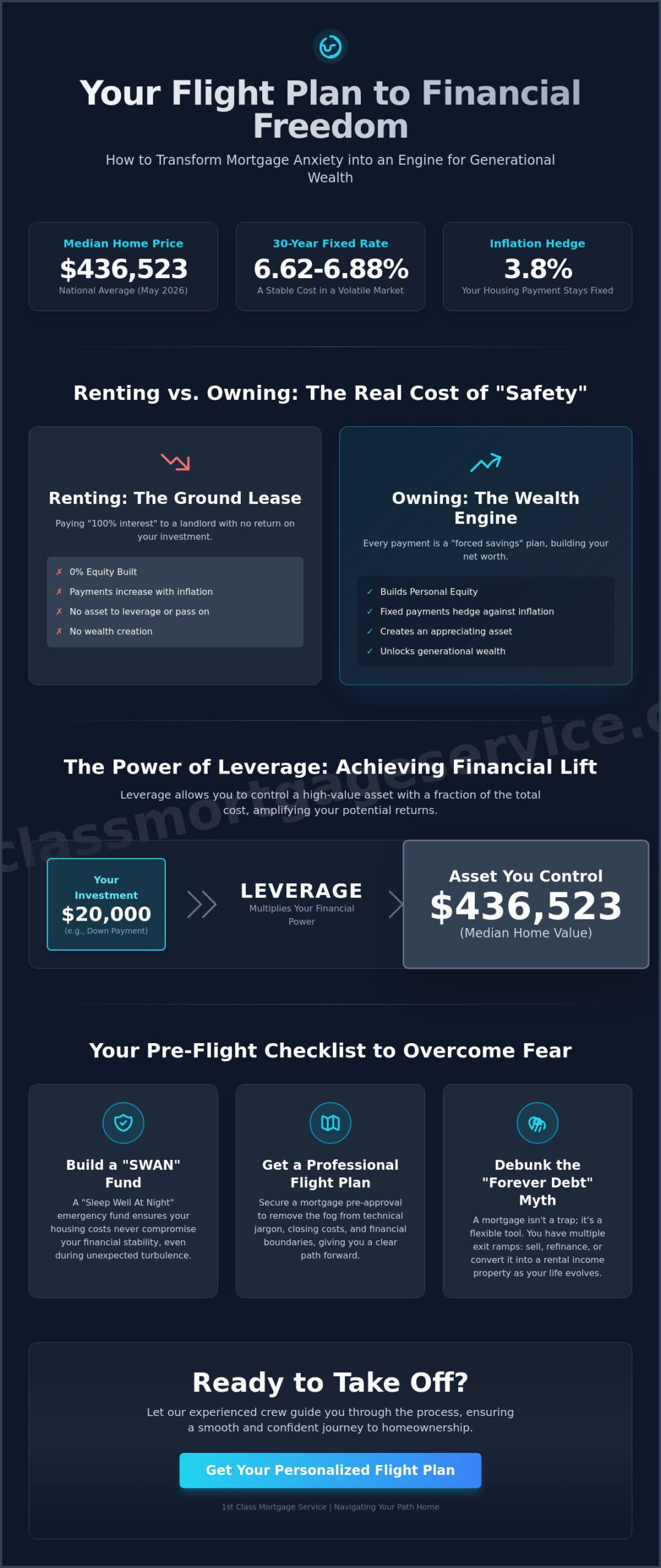
Think of your mortgage not as a heavy anchor, but as the engine that provides the necessary momentum for your net worth to climb. Most people view debt as a singular category of “owing money,” yet there’s a massive mechanical difference between depreciating debt and appreciating debt. Credit cards or auto loans are like carrying extra weight in the cargo hold; they lose value over time and offer no return on investment. In contrast, real estate is an appreciating asset. While you pay down the principal balance, you’re participating in a process of forced savings. Every monthly payment increases your ownership stake in an asset that, as of May 2026, has reached a median price of $436,523 nationally. This shift in perspective is the first step in mastering the fear of mortgage debt and how to overcome it.
In 2026, a fixed rate mortgage also serves as a powerful hedge against inflation, which recently jumped to 3.8%. When you lock in a 30-year fixed rate between 6.62% and 6.88%, your housing cost remains static while the value of the dollar decreases and the price of goods rises. You’re essentially paying back the bank with “cheaper” dollars in the future while your home value continues its historical upward trajectory. This creates a stable financial environment where your biggest expense is protected from the volatility of the rental market. If you ever feel the weight of the commitment, there are resources available to help you find freedom from an overwhelming mortgage through strategic planning and professional guidance.
Leverage: The Secret to “Lift”
Leverage is the mechanical lift that gets your financial journey off the ground. It allows you to control a high value asset with only a fraction of the total cost upfront. Imagine you have $20,000. If you leave that money in a standard savings account, it grows only by the interest rate provided by the bank. However, if you use that $20,000 as a down payment on a home, you now control the appreciation on the full purchase price of the property, not just your initial investment. This multiplier effect is what allows families to build significant wealth over time, turning a small amount of seed capital into a substantial equity position.
Good Debt vs. Bad Debt
The distinction between good and bad debt comes down to the destination. Good debt is a strategic tool used to acquire an asset that grows in value or produces income. Securing a purchase mortgage in Kalamazoo is a prime example of this strategy. Beyond the equity growth, there are often significant tax advantages associated with mortgage interest. Homeowners can currently deduct the interest paid on the first $750,000 of their mortgage debt, though you should always consult a CPA to see how this applies to your specific tax bracket. By choosing the right loan program, you transform a monthly liability into a long-term wealth-building machine that serves your family for generations.
Renting vs. Owning: Evaluating the Real Cost of “Safety”
Choosing to rent often feels like staying on the tarmac to avoid a bumpy flight. It seems safe because you aren’t responsible for the mechanical upkeep of the building. However, this safety is an illusion that carries its own set of risks. Renters face uncontrolled price hikes and the constant possibility of non-renewal. When you pay rent, your interest rate is effectively 100%. You’re funding someone else’s equity while gaining zero ownership for yourself. This realization is a vital component in addressing the fear of mortgage debt and how to overcome it. By choosing a home loan, you exchange the volatile winds of the rental market for the steady altitude of a fixed monthly payment.
Maintenance costs are frequently cited as a reason to stay grounded. While it’s true that homeowners must budget for repairs, these costs are the price of maintaining a valuable asset. In May 2026, with housing inventory up 4.2% year-over-year, buyers have more leverage than in previous seasons. The equity you build over time typically far outweighs the cost of a new water heater or roof repair. You’re investing in your own future rather than simply consuming a service provided by a landlord.
The Opportunity Cost of Waiting
Many families in Portage and Battle Creek wait for the perfect moment to buy, hoping for a significant dip in rates or prices. However, while you wait, the market continues to move. As of March 2026, home prices grew by 0.4% year-over-year. Even a small increase can add thousands to your purchase price, often negating any savings from a slightly lower interest rate. Opportunity cost is the price of the path not taken. If you stay on the sidelines too long, you might find that the home you wanted has climbed to a higher price bracket, leaving you with less buying power than when you started.
Rent is a Ceiling, Mortgage is a Floor
There is a fundamental difference in how these two housing costs behave over time. Rent is the absolute minimum you will pay for your housing each month; it can only go up from there. Conversely, a fixed-rate mortgage payment is the maximum you will pay for your principal and interest. As inflation impacts the economy, your mortgage stays flat while your income likely increases. This effectively locks in your cost of living for decades. It provides a stable floor for your financial life, allowing you to plan for the future without worrying about a landlord’s next move.
Practical Strategies to Overcome Fear and Mitigate Risk
Managing the fear of mortgage debt and how to overcome it requires a shift from emotional reaction to engineered preparation. You wouldn’t board a long-distance flight without a verified flight plan. You shouldn’t sign a mortgage without one either. Safety in homeownership isn’t found in avoiding the commitment, but in building the mechanical reserves to handle any turbulence that comes your way. By following a structured approach, you can transform a source of anxiety into a controlled, predictable journey toward wealth.
- Build a SWAN fund: Create a “Sleep Well at Night” emergency fund that covers 3 to 6 months of your full housing payment, including principal, interest, taxes, and insurance (PITI). Knowing you have this reserve prevents minor life setbacks from feeling like a financial crash.
- Secure a professional Flight Plan: Obtain a pre-approval to define your true boundaries. This removes the “fog” of technical jargon and ensures you only look at homes that fit within your comfort zone.
- Stress-test your budget: Simulate potential life changes like a job transition or family expansion. If your budget can withstand these scenarios, your confidence will naturally rise.
- Utilize local safety nets: Leverage specific Michigan first time home buyer programs designed to provide stability for local families.
Leveraging MSHDA and Down Payment Assistance
For many in the Kalamazoo area, the biggest barrier to takeoff is the initial cash requirement. Programs like MSHDA Down Payment Assistance act as navigational aids, allowing you to preserve your personal savings. When you keep more “fuel” in your own bank account after closing, your mortgage anxiety drops significantly. You aren’t just buying a home; you’re doing so while maintaining a liquid safety net. This strategic use of assistance programs ensures you aren’t “house poor” the moment you receive your keys.
The Power of the 15-Year vs. 30-Year Choice
Choosing your flight duration is a deeply personal decision. A 15-year mortgage offers the psychological benefit of a shorter term and lower total interest, making it feel like a faster trip to total freedom. However, a 30-year Conventional Mortgage provides the flexibility of a lower required monthly payment. You can always “manually accelerate” your 30-year loan by making extra principal payments when your budget allows. This puts you in total control of the cockpit, allowing you to increase your speed when the skies are clear and throttle back if things get bumpy. To find which path fits your specific goals, you can explore our available loan programs today.
Navigating Your Path with an Experienced Kalamazoo Guide
Addressing the fear of mortgage debt and how to overcome it is much easier when you aren’t flying solo. A local mortgage expert acts as your flight navigator. They help you interpret the complex data on your dashboard and adjust your course during periods of economic turbulence. In a market where the national median home price has reached $436,523, you need more than just a lender; you need a steady, reliable ally. This partnership shifts the emotional frequency of the process from a cold, transactional exchange to a supportive relationship built on individualized care and mutual respect. We believe that clarity is the best way to clear the psychological fog that often surrounds a home loan.
Transparency is the cornerstone of our approach. We ensure there’s no hidden “fog” in your closing costs or origination fees. While industry standards for these fees typically range from 0.5% to 1% of the loan amount, we focus on providing a clear breakdown so you know exactly where every dollar is going. Jeremy Drobeck is deeply committed to being present for the entire journey, from the initial takeoff to the final landing. A personalized strategy session can help debunk your specific financial “ghosts.” Whether you’re worried about credit history or the current 6.62% to 6.88% interest rates, we provide the data-driven reassurance you need to stay on track.
Tailored Solutions for West Michigan
Our team understands the unique dynamics of the Kalamazoo, Portage, and Battle Creek markets. We don’t offer generic advice because your financial situation isn’t generic. We specialize in simplifying complex government-backed programs, including FHA, VA, and USDA mortgages. By matching your goals with the right mechanical components, like a Renovation Mortgage or a Conventional Mortgage, we provide the stability you need to reach your destination. This neighborly approach is vital in a high-stakes financial world. We treat your homeownership journey as the significant life milestone it is, ensuring you have a seasoned navigator who knows the local landscape as well as you know your own backyard.
Your Next Milestone Starts with a Conversation
It’s time to view homeownership as a milestone rather than a millstone. The weight of debt is far easier to carry when it’s structured as a strategic tool for wealth rather than a burden. With housing inventory up 4.2% year-over-year as of May 2026, the current market offers a unique window of opportunity for prepared buyers. You have the power to lock in your housing costs and start building equity today. Don’t let uncertainty keep you grounded. Schedule your Kalamazoo mortgage navigation session today with Jeremy Drobeck and let’s begin drafting your personalized flight plan toward financial freedom.
Take Control of Your Financial Destination
The journey toward homeownership doesn’t have to be a high-stress gamble. By reframing your mortgage as a strategic engine for wealth rather than a heavy burden, you gain the lift needed to reach a higher financial altitude. We’ve explored how a fixed monthly payment provides a stable floor against the rising winds of the rental market and how practical tools like a SWAN fund can keep your flight path smooth. The fear of mortgage debt and how to overcome it is a challenge best met with preparation and expert navigation.
With over 20 years of local expertise in Kalamazoo and a specialization in MSHDA and first-time buyer programs, Jeremy Drobeck is here to ensure your takeoff is as smooth as your landing. As a division of Neighborhood Loans, Inc. (NMLS #222982), we provide the transparency and neighborly care you deserve for this major life milestone. Ready to chart your course? Contact Jeremy Drobeck for a personalized mortgage flight plan. Your future home is waiting, and the skies are clearer than you think.
Frequently Asked Questions
Is it normal to feel terrified before signing a mortgage?
Yes, feeling a surge of adrenaline before a major commitment is a biological response. Your brain is trying to protect you from perceived risk by triggering a survival instinct. This fear of mortgage debt and how to overcome it starts with acknowledging that anxiety is a sign of respect for the process, not a reason to stay grounded. Once you understand the mechanics of the loan, that fear transforms into a controlled sense of preparation.
How do I know if I am taking on too much mortgage debt?
You’ll know your limits by looking at your monthly cash flow rather than just the total loan amount. We recommend keeping your total housing payment within a range that allows for a “Sleep Well at Night” fund. If your monthly obligations prevent you from saving for future maintenance or life goals, you might be over-leveraged. A clear flight plan helps define these boundaries before you ever make an offer on a home.
What happens if I lose my job and cannot pay my mortgage?
If you face a job loss, the first step is to contact your loan servicer immediately to discuss loss mitigation options. Most modern mortgages have built-in safety valves like forbearance programs that can provide temporary relief during a transition. Having a three to six month emergency fund acts as your reserve fuel tank. It gives you the time needed to find a new position without risking your home’s stability.
Is it better to pay off debt or save for a down payment first?
Prioritizing high-interest “depreciating” debt, like credit cards, is usually the best first step. These debts act like dead weight on your financial engine and offer no return. However, you don’t necessarily need to be debt-free to buy a home. Programs like MSHDA Down Payment Assistance can help you preserve cash for a down payment while you continue to manage other obligations, allowing you to start building equity sooner.
How does inflation affect my mortgage debt over time?
Inflation is actually a homeowner’s secret ally. As the cost of goods and services rises, the real value of your fixed-rate debt decreases because you’re paying it back with dollars that have less purchasing power. Meanwhile, the value of your home typically keeps pace with or exceeds inflation. This dynamic turns your mortgage into a powerful hedge that protects your cost of living for decades while your equity grows.
Can I get a mortgage if I already have significant student loan debt?
Yes, significant student loan debt doesn’t automatically disqualify you from homeownership. Lenders look at your monthly payment obligation rather than the total balance when calculating your eligibility. Many loan programs, such as FHA or Conventional mortgages, have specific guidelines for how student loans are factored into your flight plan. We can help you navigate these rules to see how much “lift” you still have available for a home purchase.
What is the “debt-to-income ratio” and why does it matter for my peace of mind?
The debt-to-income (DTI) ratio is the percentage of your gross monthly income that goes toward paying debts. It serves as the primary fuel gauge for your financial safety. A lower DTI means you have more “airspeed” to handle unexpected expenses or changes in the economy. Understanding this number provides peace of mind because it proves your mortgage is a calculated, sustainable part of your monthly budget.
How can a local mortgage broker in Kalamazoo help me overcome my fears?
A local guide provides the neighborly reassurance and regional expertise that big-box lenders often lack. Our team understands the specific market dynamics in Kalamazoo and Portage, helping you avoid the “fog” of hidden costs or technical jargon. We focus on the fear of mortgage debt and how to overcome it by offering transparent, end-to-end support. This partnership ensures you feel in total control of the cockpit from pre-approval to closing.



Latest Blog Post
S.O.S. SAVE OUR SALE
S.O.S. SAVE OUR SALE: WHAT TO DO WHEN YOUR LENDER STALLS WEEKS BEFORE CLOSING!
 Did your mortgage lender suddenly go radio silent, request the same bank statement for the fourth time, or drop a last-minute loan denial right before your scheduled closing date?
Yesterday, a panicked real estate agent called my office from Portage. Their buyer had been under contract for three weeks on a home near Milwood. The closing date sat just nine days away.
Out of nowhere, the buyer’s out-of-state call-center lender issued a denial letter. The call-center underwriter miscalculated self-employment write-offs, panicked over an unpermitted porch repair on the appraisal, and threw the entire transaction into the trash can.