How Much Do You Have to Put Down on a House in Kalamazoo (2026 Guide)
What if the 20 percent down payment rule is just a heavy piece of luggage you don’t actually need to carry to the gate? I know that looking at the 2026 housing market in Kalamazoo can feel like staring at a turbulent flight path. With interest rates shifting and home prices in West Michigan holding steady, it’s easy to feel stuck on the runway because you think you need a massive pile of cash just to get airborne. You’re likely asking exactly how much do you have to put down on house purchases in today’s market, especially when you’re hearing conflicting advice from every corner.
Think of down payment assistance programs as the extra lift provided by airplane flaps; they help you get off the ground with much less weight than you’d expect. We’ll break down the specific savings goals for different loan types and highlight local grants that can slash your out-of-pocket costs. This guide provides a clear GPS coordinate for your savings and the confidence to start your pre-approval journey with a seasoned co-pilot by your side.
Key Takeaways
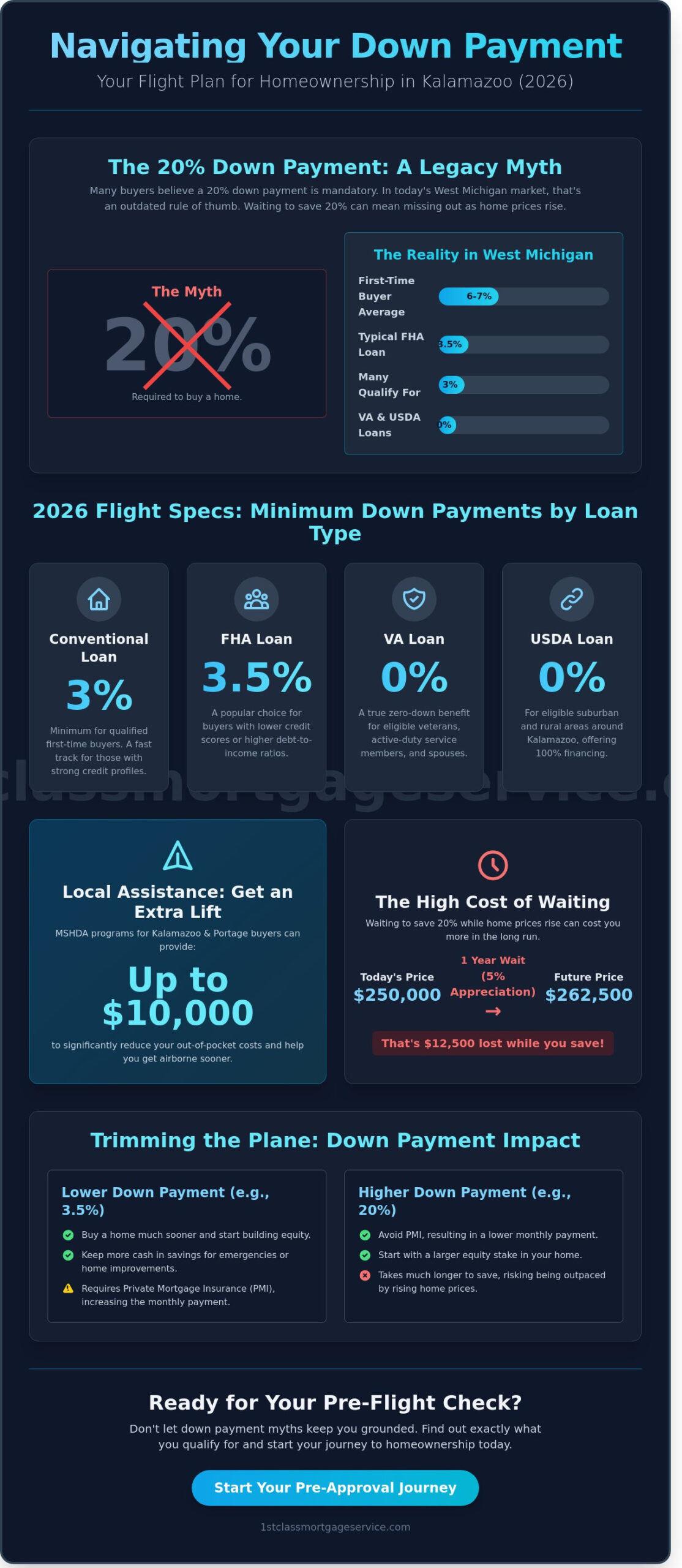
- Learn why the 20% down payment is a “legacy setting” and how most West Michigan buyers achieve lift-off with significantly less upfront.
- Discover exactly how much do you have to put down on house by reviewing the 2026 flight specs for FHA, VA, and Conventional loans.
- Identify local assistance programs like MSHDA that provide the “extra lift” of up to $10,000 for qualified buyers in Kalamazoo and Portage.
- See how your down payment size acts like “trimming the plane” to ensure your monthly payments and interest rates stay on a smooth flight path.
- Learn how to conduct a “pre-flight check” to automate your savings and build a solid financial runway for your future home.
The 20% Down Payment Myth vs. the West Michigan Reality
Many buyers think they need a massive pile of cash before they can even talk to a lender. They view the 20% down payment as a mandatory pre-flight check. It isn’t. In the current 2026 market, that 20% figure is a legacy setting from a different era of banking. Think of your down payment as your initial equity stake or the “lift” you need to get off the runway. While a larger sum helps, it’s not the only way to get airborne. If you are wondering what is a down payment in its simplest form, it’s your upfront investment that secures the loan and establishes your starting position in the property.
National headlines often focus on high-cost coastal cities, but West Michigan operates on a different flight path. For 2026, the median down payment for first-time buyers across the country has hovered around 6% to 7%. In Kalamazoo and Portage, we see successful closings every day with significantly less. You don’t need to wait until you’ve saved $60,000 to buy a $300,000 home. Our local data in Battle Creek shows that many buyers are taking flight with 3% or 3.5% down, and some qualify for 0% down programs that eliminate the entry barrier entirely. Knowing exactly how much do you have to put down on house depends on your specific financial GPS, not an outdated rule of thumb.
Why Does the 20% Rule Still Exist?
The 20% rule persists because it simplifies things for lenders. Historically, that threshold eliminated the need for Private Mortgage Insurance (PMI). PMI is a safety net for the bank, not for you. When you put down 20%, you eliminate that extra monthly “fuel” cost. It lowers your monthly commitment and reduces lender risk immediately. However, modern loan products are engineered for lower entry points. We have tools today that make PMI much more affordable, allowing you to keep more cash in your “hangar” for home improvements or emergencies. We’re here every step of the way to show you how these modern options compare to the old-school approach.
The Cost of Waiting to Save 20%
Waiting to save a full 20% can ground your dreams indefinitely. If home prices in Kalamazoo rise by 5% in a single year, a $250,000 house just became $12,500 more expensive. Most people can’t outpace the market with a standard savings account. This is the “opportunity cost” of staying in the rental market. You are effectively paying 100% interest to a landlord instead of building your own equity. Buying now with a lower down payment allows you to capture that appreciation. You start building equity as the market moves, rather than watching the runway get longer while you’re still parked at the gate. Determining how much do you have to put down on house is about balancing your current cash flow with the speed of the local market.
Minimum Down Payment Requirements by Loan Type in 2026
Before you get airborne, you need to know the length of your financial runway. Deciding how much do you have to put down on house isn’t a one-size-fits-all calculation. It depends on the specific loan engine you choose for your journey. Jeremy Drobeck – Treadstone Mortgage helps you select the right machinery for your budget, ensuring you don’t stall before you reach the clouds. Each loan type has its own flight specs, and your credit score often dictates which runway you’re cleared to use. Higher scores generally open up shorter runways, while lower scores might require a bit more preparation before liftoff.
Conventional and FHA Loan Minimums
Conventional loans offer a quick liftoff for those with strong credit profiles. In Portage, first-time buyers can often secure a 3% down payment option, which provides a fast track to homeownership without draining every cent of your savings. FHA loans require a 3.5% down payment and remain a popular choice for buyers with lower credit scores or higher debt ratios. While FHA might have a slightly different “climb” due to specific insurance requirements, it provides the necessary stability for many families in our community. Understanding these Minimum Down Payment Requirements helps you plan your cash flow before you even start looking at listings. Jeremy Drobeck – Treadstone Mortgage compares the liftoff speed of these two common options to see which one gets you to cruising altitude more efficiently.
Zero Down Options: VA and USDA Loans
For eligible borrowers, some programs offer maximum lift with 0% down. VA loans honor our veterans in Battle Creek with a true zero-down benefit, recognizing their service with the most favorable terms available. Similarly, USDA Rural Development loans target eligible areas around Kalamazoo, allowing for 100% financing in designated rural zones. It’s vital to remember that zero down doesn’t mean zero cost at the closing table. You’ll still need to account for closing costs like inspections, title fees, and taxes. These programs provide the maximum lift for eligible borrowers, but they require precise navigation to execute correctly. If you’re also concerned about your credit history, our detailed breakdown of first-time home buyer loans with bad credit and zero down explains exactly which programs are available to help you clear the runway in Kalamazoo.
Jeremy Drobeck – Treadstone Mortgage acts as your seasoned co-pilot, helping you navigate these nuances. Jeremy Drobeck – Treadstone Mortgage ensures you understand exactly how much do you have to put down on house while keeping your total flight costs in check. Jeremy Drobeck – Treadstone Mortgage specializes in finding the right engine to fit your specific financial trajectory. If you’re ready to see which program fits your goals, you can explore our 1st Class mortgage service for a personalized flight plan. We’re here every step of the way to ensure your landing is just as smooth as your takeoff.
Kalamazoo & Portage: Local Down Payment Assistance Programs
If you’re staring at your bank balance and wondering how much do you have to put down on house in 2026, take a deep breath. You don’t have to carry the entire weight of the down payment on your own. Think of local assistance programs as the flaps on an airplane wing; they provide the extra lift needed for a smooth takeoff when your personal savings might be a bit light. In Michigan, we have access to some of the most robust support systems in the country to help you clear the hurdle of initial costs. If you want a comprehensive overview of every option available to you, our detailed guide to Michigan first time home buyer programs covers the full landscape of 2026 assistance for Kalamazoo residents.
The Michigan State Housing Development Authority (MSHDA) is the premier state-funded program designed to bridge the gap for first-time buyers. It isn’t a “too good to be true” myth. It’s a calculated financial tool built to help Michiganders transition from renting to owning. For many, this is the difference between staying grounded and finally getting airborne.
MSHDA Down Payment Assistance (DPA) Explained
One of the most effective tools in our flight kit is the MI 10K DPA Loan. This program provides up to $10,000 in assistance to help cover your down payment and closing costs. Unlike a traditional loan that adds to your monthly overhead, MSHDA utilizes a “silent second” mortgage structure. This means the $10,000 sits quietly in the background. You don’t make monthly payments on it. The loan is only repaid when you sell the home, pay off your primary mortgage, or refinance your property.
To qualify for this lift, you’ll need to meet specific eligibility requirements. As of 2026, borrowers typically need a minimum credit score of 640. There are also household income limits and sales price maximums that vary by county. In the Kalamazoo and Portage areas, these limits are designed to support moderate-income families. We can look at your specific flight path to see if your income falls within the current MSHDA boundaries and ensure your credit score is ready for the runway.
Local Grants and Community Partner Programs
Beyond state-level support, local municipal grants provide targeted assistance for specific neighborhoods. The City of Kalamazoo and Battle Creek often offer “Homeownership Assistance” initiatives for buyers looking within city limits. These local grants can sometimes be layered with certain loan products, further reducing how much do you have to put down on house at the closing table. These programs are often first-come, first-served, so timing your application is vital.
Kalamazoo County also maintains initiatives to encourage community stability through homeownership. Because these programs have unique paperwork and inspection requirements, it’s essential to work with a local co-pilot. We know the local landscape and can help you navigate the specific requirements of city-funded grants. We’re here every step of the way to ensure you’re utilizing every available dollar to make your home purchase a reality.
Analyzing the Impact: Small vs. Large Down Payments
Deciding how much do you have to put down on house depends on your specific flight plan. Let’s look at a $250,000 home in Kalamazoo as our test flight. If you choose a 3.5% down payment, you are bringing $8,750 to the closing table. At a 10% down payment, that number climbs to $25,000. While the upfront cost is higher, a larger down payment acts like trimming the plane for a smoother flight. It reduces the drag on your monthly cash flow and can often result in better interest rate pricing because the lender takes on less risk.
Putting more money down also improves your debt-to-income (DTI) ratio. A lower loan balance means a smaller monthly obligation, which gives you more breathing room in your budget for other life goals. However, the most common question I hear is whether it’s better to put every cent toward the house or keep cash in the bank. The answer is rarely all or nothing. You want enough lift to get off the ground without stalling your personal savings. I help my clients evaluate these trade-offs so they can make a decision that feels secure for the long haul.
Private Mortgage Insurance (PMI) Realities
For many West Michigan buyers, PMI is a misunderstood part of the process. On a typical starter home in Portage or Kalamazoo, monthly PMI might range from $40 to $125 depending on your credit score and loan type. Think of PMI as a tool that allows you to get airborne much sooner than if you waited to save a full 20%. Once your home reaches 20% equity altitude through market appreciation or scheduled payments, you can usually request to have PMI removed. It’s a temporary cost for a permanent asset.
Cash Reserves and Post-Closing Stability
You should never empty the fuel tank just to hit a specific down payment goal. Buying a home in Battle Creek or St. Joseph requires more than just the initial check. New homeowners often face immediate needs like a new lawnmower, unexpected furnace repairs, or minor cosmetic renovations. Keeping a solid emergency fund ensures your post-closing experience is stable and stress-free. We always look at your “cash to close” alongside your remaining reserves to ensure you aren’t flying on fumes after you get the keys.
Connect with our team for a personalized mortgage flight plan today.
Building Your Flight Plan: How to Start Saving Today
Preparing for a home purchase in 2026 requires more than just a piggy bank; it requires a flight plan. You don’t want to reach the end of your savings journey only to realize you’re short on fuel. By taking specific, engineered steps now, you can ensure a smooth takeoff when you finally find that perfect West Michigan property.
- Step 1: Get a “pre-flight check.” Schedule a mortgage consultation immediately. This isn’t about getting a loan today. It’s about seeing your real numbers. A professional can tell you exactly how much do you have to put down on house based on your specific debt-to-income ratio and the current 2026 market conditions.
- Step 2: Automate your “Home Runway” account. Treat your down payment like a mandatory monthly bill. Set up an automatic transfer into a high-yield savings account dedicated solely to your home. When the money never hits your checking account, you won’t be tempted to spend it.
- Step 3: Audit your spending for “extra lift.” Look at your monthly bank statements from the last 90 days. Identify recurring subscriptions or dining habits that don’t serve your goal. Redirecting $200 a month into your savings can add thousands to your “lift” over a year.
- Step 4: Explore gift funds. In the West Michigan market, many buyers use gift funds from family members to bridge the gap. There are specific rules for these loans; the funds must be documented with a “gift letter” and a clear paper trail from the donor’s account.
- Step 5: Partner with a local expert. Working with Jeremy Drobeck ensures you have a seasoned co-pilot who understands the local nuances of Kalamazoo, Portage, and St. Joseph.
The Importance of Pre-Approval
Think of pre-approval as the GPS for your entire home search. Without it, you’re flying blind. Knowing your exact budget changes the way you browse Zillow or Redfin. It prevents the heartbreak of falling in love with a home that isn’t airworthy for your finances. A solid pre-approval from a local lender also makes your offer stand out to sellers, proving you have the financial backing to close the deal. You can start this process by visiting our purchase mortgage resources to see which programs fit your goals.
Timeline for Success
You should start talking to a lender 6 to 12 months before you plan to move. This window allows you to address any issues that might keep you grounded. If your credit score needs a “tune-up” to qualify for a lower interest rate, you’ll have the time to pay down balances or dispute errors. Waiting until the last minute often leads to turbulence. Start your journey with a clear path forward and schedule your 1st Class mortgage consultation today. We are here to help you calculate exactly how much do you have to put down on house so you can land safely in your new home.
Clear for Takeoff: Your 2026 Kalamazoo Homeownership Strategy
The 20% down payment isn’t a hard requirement; it’s a persistent myth that keeps too many Michigan families stuck on the tarmac. In 2026, the reality is that specialized programs like MSHDA and local Portage assistance grants provide the extra lift needed to reach your goal with significantly less upfront cash. Whether you choose a 3% entry point or decide to invest more to lower your monthly fuel costs, the right strategy depends entirely on your specific flight plan. Knowing exactly how much do you have to put down on house in the current Kalamazoo market requires looking at your unique financial GPS with a seasoned co-pilot. Jeremy Drobeck brings over 20 years of experience navigating the West Michigan mortgage landscape. You’ll receive expert guidance on local assistance programs and the personal attention that defines 1st Class service. We’re here every step of the way to ensure your transition from renter to homeowner is smooth, steady, and respectful of your budget.
Ready for takeoff? Schedule your personalized mortgage consultation with Jeremy Drobeck today!
Your dream home in West Michigan is within reach, and we’re ready to help you land it.
Frequently Asked Questions
Is there a minimum credit score for a 3% down payment in Michigan?
You generally need a minimum credit score of 620 to qualify for a 3% down payment program in Michigan. For many conventional low down payment options, lenders look for that 620 benchmark to ensure your financial flight path is stable. If you use MSHDA programs to help cover that 3% requirement, you will typically need a 640 score to gain clearance for takeoff.
Can I use a gift from my parents for my down payment in Kalamazoo?
You can absolutely use a financial gift from your parents for your down payment on a home in Kalamazoo. Most conventional and FHA guidelines allow 100% of your down payment to come from an immediate family member. We simply need a signed gift letter and a clear paper trail showing the funds moving to your account to keep your closing on schedule.
How much are closing costs in Michigan compared to the down payment?
Closing costs in Michigan typically range from 2% to 5% of the home purchase price, which is a separate expense from your down payment. While your down payment represents your initial equity stake, closing costs cover essential items like taxes, title insurance, and underwriting fees. If you are wondering how much do you have to put down on house purchases, remember to budget for both the fuel and the landing fees.
What happens if I put less than 20% down on a house?
Putting less than 20% down on a house usually requires you to pay Private Mortgage Insurance, also known as PMI. This insurance protects the lender if the loan defaults and acts like extra lift for your mortgage, allowing you to buy a home sooner. When you ask how much do you have to put down on house listings, remember that PMI can be removed once you reach 20% equity.
Does MSHDA assistance have to be paid back?
Yes, MSHDA down payment assistance must be paid back when you sell the home, refinance the mortgage, or pay off the primary loan. It functions as a 0% interest, non-amortizing second mortgage rather than a grant. Think of it as a temporary boost that helps you get airborne; the balance stays with the property until you decide to change your flight plan or move to a new destination.
Is it better to put 0% down if I qualify for a VA or USDA loan?
Choosing 0% down through a VA or USDA loan is often better for preserving your cash reserves for home repairs or emergencies. Since VA loans do not require monthly mortgage insurance, they provide a very efficient runway for veterans to achieve homeownership. USDA loans do have an annual fee, so we should compare the long term interest costs against the benefit of keeping your savings in the bank.
Can I use my 401k for a down payment on a house in Portage?
You can use your 401k funds for a down payment on a house in Portage by either taking a loan against the account or a withdrawal. Most 401k plans allow you to borrow up to $50,000 or 50% of your vested balance for a primary residence purchase. This is a common way to find the necessary lift for your down payment without waiting years to save post-tax income.
How long does it take to get MSHDA approval?
MSHDA approval typically adds about 10 to 14 days to the standard mortgage underwriting timeline. Because MSHDA requires a second layer of review by the state agency, we usually plan for a 45 day closing window instead of the traditional 30 day period. Our team acts as your co-pilot to ensure all paperwork is filed correctly so there are no unexpected delays at the gate.



Latest Blog Post
S.O.S. SAVE OUR SALE
S.O.S. SAVE OUR SALE: WHAT TO DO WHEN YOUR LENDER STALLS WEEKS BEFORE CLOSING!
 Did your mortgage lender suddenly go radio silent, request the same bank statement for the fourth time, or drop a last-minute loan denial right before your scheduled closing date?
Yesterday, a panicked real estate agent called my office from Portage. Their buyer had been under contract for three weeks on a home near Milwood. The closing date sat just nine days away.
Out of nowhere, the buyer’s out-of-state call-center lender issued a denial letter. The call-center underwriter miscalculated self-employment write-offs, panicked over an unpermitted porch repair on the appraisal, and threw the entire transaction into the trash can.