
Scaling Your Portfolio: How the 5-9 Unit DSCR Loan Program Changes Everything for Multi-Family Investors
Ready to Go Bigger?
![]()
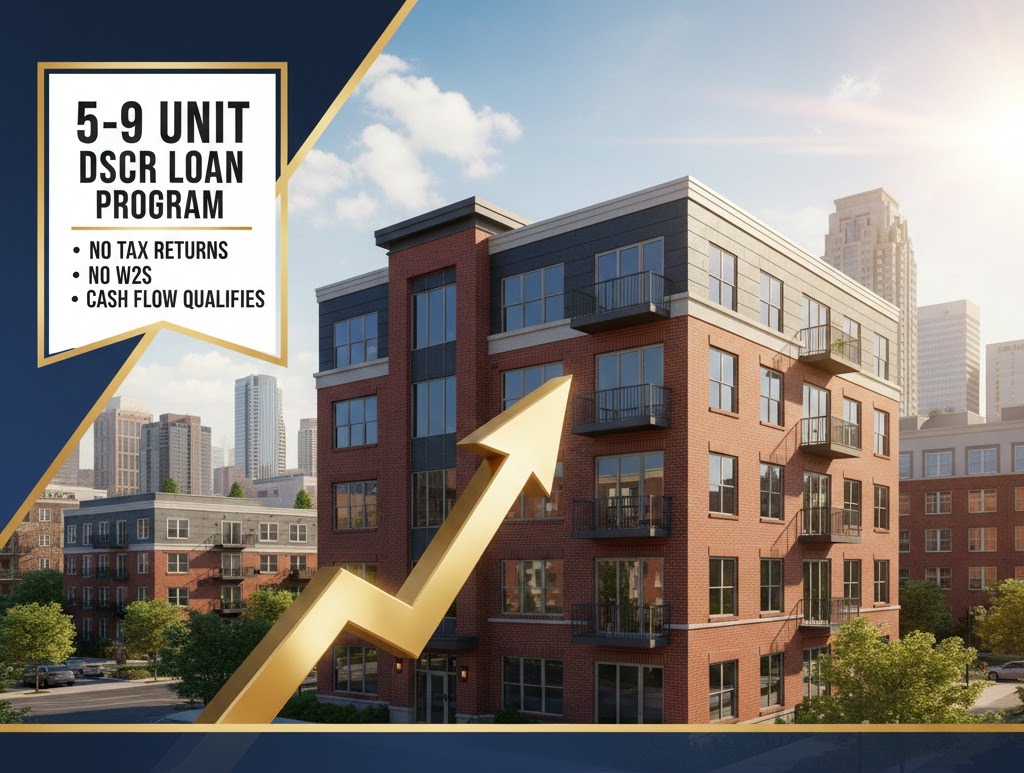
For serious real estate investors, the journey often hits a bottleneck when moving past the traditional 1-4 unit property threshold. Conventional financing becomes complicated, requiring extensive personal income documentation, tax return analysis, and strict debt-to-income (DTI) ratio checks that can limit your borrowing capacity—and, ultimately, your wealth growth.
If you are ready to scale up your portfolio and transition into larger, more profitable multi-family assets, we have the specialized solution you need: our 5-9 Unit DSCR Loan Program.
The Sweet Spot: Why 5-9 Units Matters
When you step into the 5-9 unit space, you move from residential financing into commercial lending, which typically means more stringent underwriting. However, this is where the opportunity for greater cash flow and economies of scale truly begins. Our program bridges this gap, making the transition smoother and more profitable.
Our specialized loan is designed to directly finance 5 to 9 units in a single transaction, bypassing the limitations often encountered by investors trying to acquire larger buildings with traditional bank products.
The True DSCR Advantage: Cash Flow Qualification
The most powerful feature of this program is the Debt Service Coverage Ratio (DSCR) qualification model.
DSCR Only means we assess the viability of the loan based on the property’s ability to generate sufficient rental income to cover the mortgage payment—not your personal tax returns or W2s.
- No Tax Returns or W2s: Say goodbye to complex documentation that often fails to reflect the true financial strength of a seasoned investor.
- Property Pays for Itself: The rental income is the qualification metric. If the property cash flows, the deal works. This frees up your personal DTI and allows you to acquire more properties faster.
Accelerate Your Wealth Building
This specialized approach does more than just simplify underwriting; it accelerates your entire investment strategy:
- Fast Closings: Because the documentation process is significantly streamlined (focusing on the property, not your personal life), we can facilitate lightning-fast closings, ensuring you don’t lose out on competitive deals in a hot market.
- Competitive Rates: Our program offers competitive rates tailored specifically to the multi-family investment sector, maximizing your return on investment.
Stop letting conventional financing hold back your potential. It’s time to leverage the income-producing power of real estate and let the rental revenue qualify the deal.
Ready to grow your wealth? Contact us today to discuss your next multi-family acquisition. Call us at 269-360-7109 or Apply Online !



Latest Blog Post
S.O.S. SAVE OUR SALE
S.O.S. SAVE OUR SALE: WHAT TO DO WHEN YOUR LENDER STALLS WEEKS BEFORE CLOSING!
 Did your mortgage lender suddenly go radio silent, request the same bank statement for the fourth time, or drop a last-minute loan denial right before your scheduled closing date?
Yesterday, a panicked real estate agent called my office from Portage. Their buyer had been under contract for three weeks on a home near Milwood. The closing date sat just nine days away.
Out of nowhere, the buyer’s out-of-state call-center lender issued a denial letter. The call-center underwriter miscalculated self-employment write-offs, panicked over an unpermitted porch repair on the appraisal, and threw the entire transaction into the trash can.